
At a glance
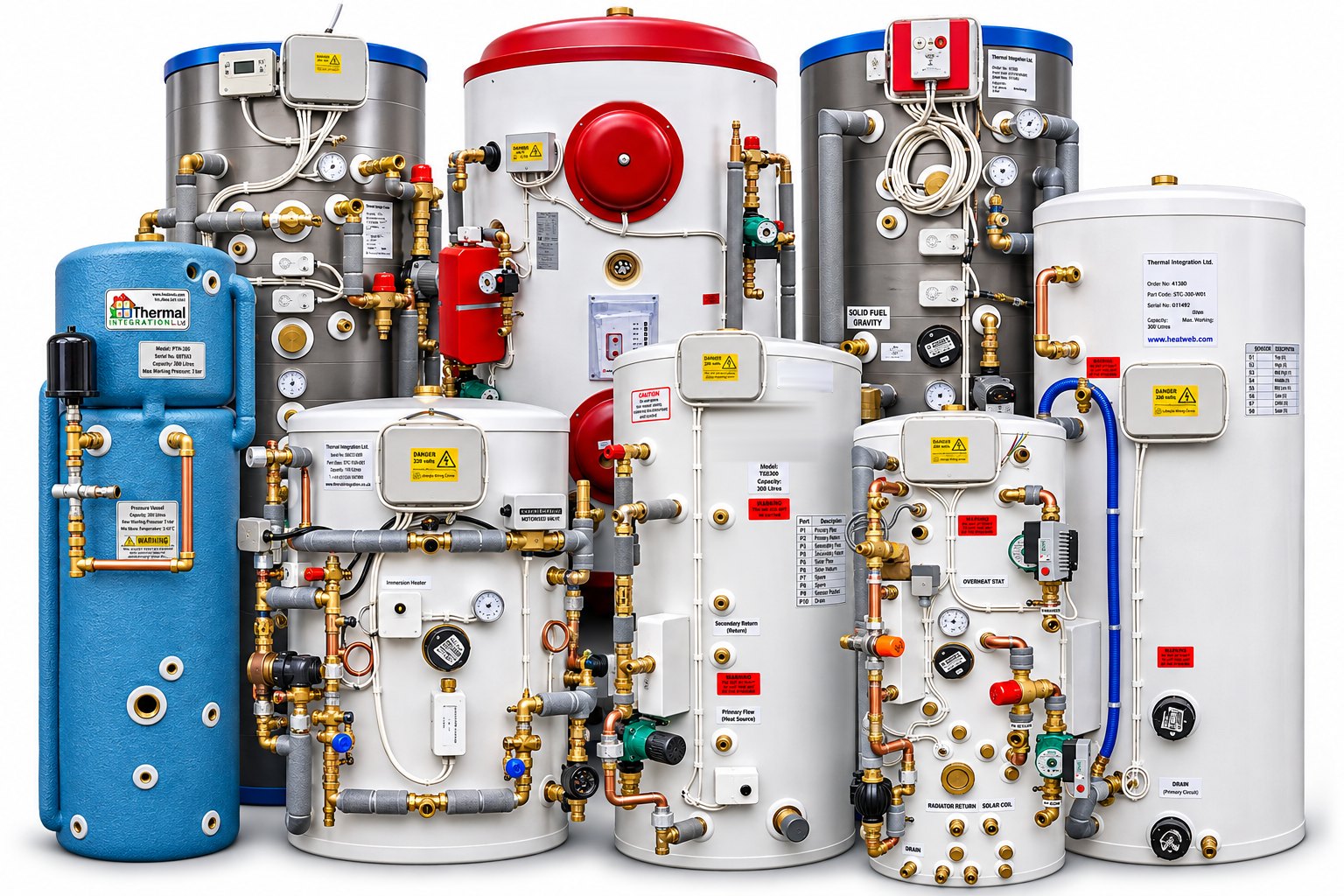
| Products | HEATBANK thermal stores: the multi-fuel Xcel, the PANDORA (no discharge pipe), electric storage and district heating versions |
| Years | From the late 1980s until 2023, as Dedicated Pressure Systems and then Thermal Integration |
| Supplied | Over 10,000, many thousands custom built for a specific selection of heat sources |
| Heat sources | Wood burners, biomass, solar thermal, gas and oil boilers, heat pumps, electric elements and district heat, several at once |
| How they were supplied | Prefabricated and plug-and-play: we took on the design, manufacture, installer training and a lifetime warranty |
| Sold through | Local authorities, housebuilders and, at the peak, over 30 renewable and biomass outlets, including stove shops |
| Today | Heatweb designs thermal storage for heat networks and multi-source systems, on any scale |
Combining heat sources: the HEATBANK Xcel
The Xcel was designed to answer 95% of the enquiries we received. Before it, everything was custom made, and customers often came back wanting to add a heat source later. The Xcel had up to 28 connections, each sized and placed from 25 years of multi-fuel design, so almost any combination of heat sources and loads could be connected on day one or added later: two 1½" bosses for gravity circulation from larger wood burners, a solar coil in the base, and connections for boilers, heat pumps, immersion heaters, radiators, underfloor heating and several hot water outlets at the same time.
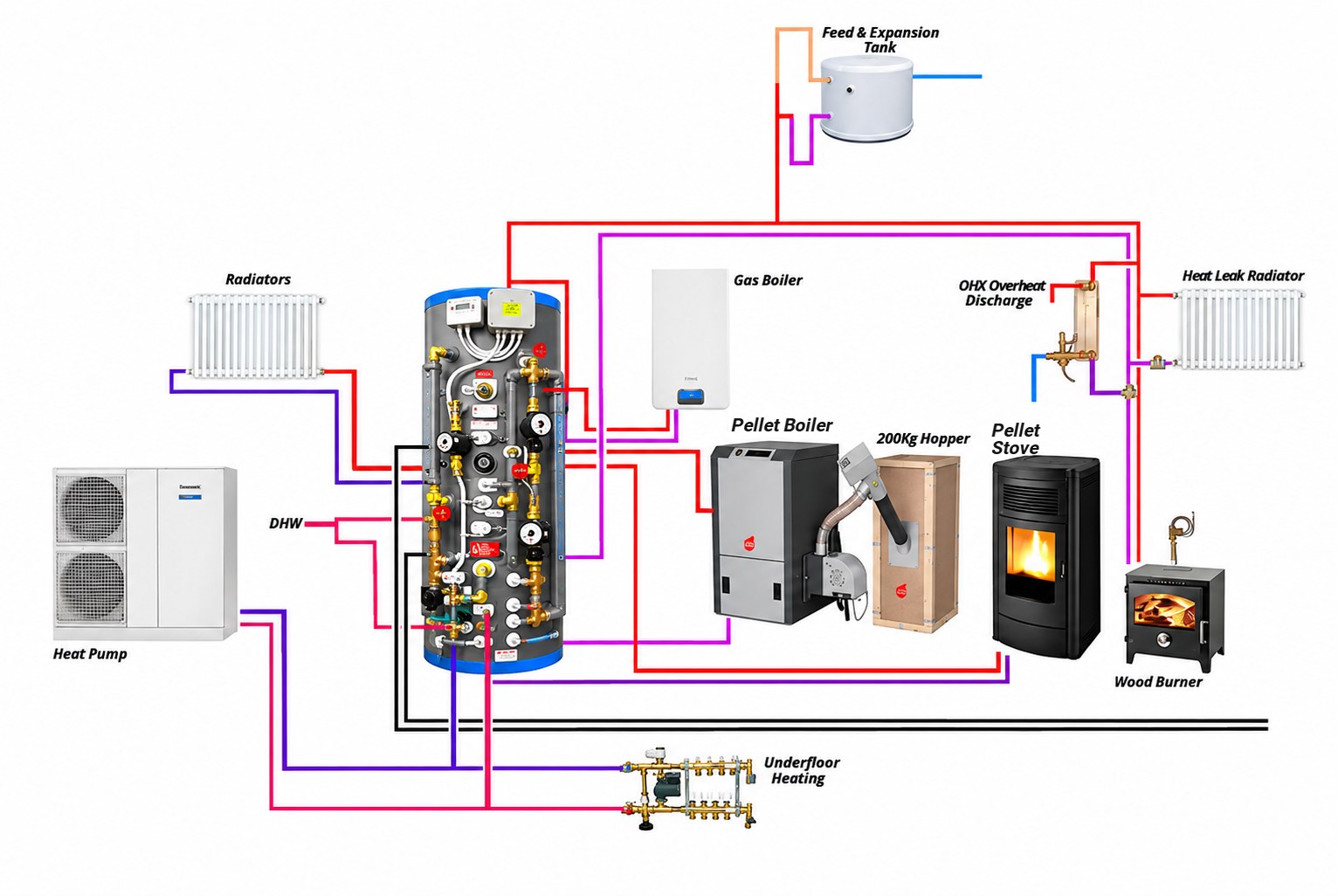
What made it work was the arrangement inside and around the store:
- Patented top-down reheating. A boiler recirculates until it reaches 70 °C and then feeds the very top of the store, so hot water is usable within a minute instead of half an hour. A return temperature valve keeps condensing boilers condensing and stops boiler rot in oil and pellet boilers. Only as much of the store is heated as the occupants need, leaving cold water at the bottom for solar and the wood burner.
- Temperatures matched to loads. Low temperature loads such as underfloor heating draw from the part of the store fed by low temperature sources such as heat pumps, and radiators from the part fed by wood burners and boilers. With heat pumps, measured operating data was used to fine-tune storage layouts and baffles.
- Patented overheat protection that works in a power cut. A wood burner does not switch off. If the store ever passes 95 °C, a mechanical valve passes mains water through a heat exchanger in the top of the store, removing over 12 kW with no power at all. Fourteen wood burner manufacturers approved the Xcel.
- Built to last. Duplex stainless steel, welded in a factory that also made nuclear waste containers, with factory-fitted controls chosen for reliability, not price.
At both Ecobuild 2008 and 2009 an Xcel was at the centre of the show's Zero Carbon House, with wood burners, solar thermal and a small biomass heat network.
Plug and play: we took the design responsibility
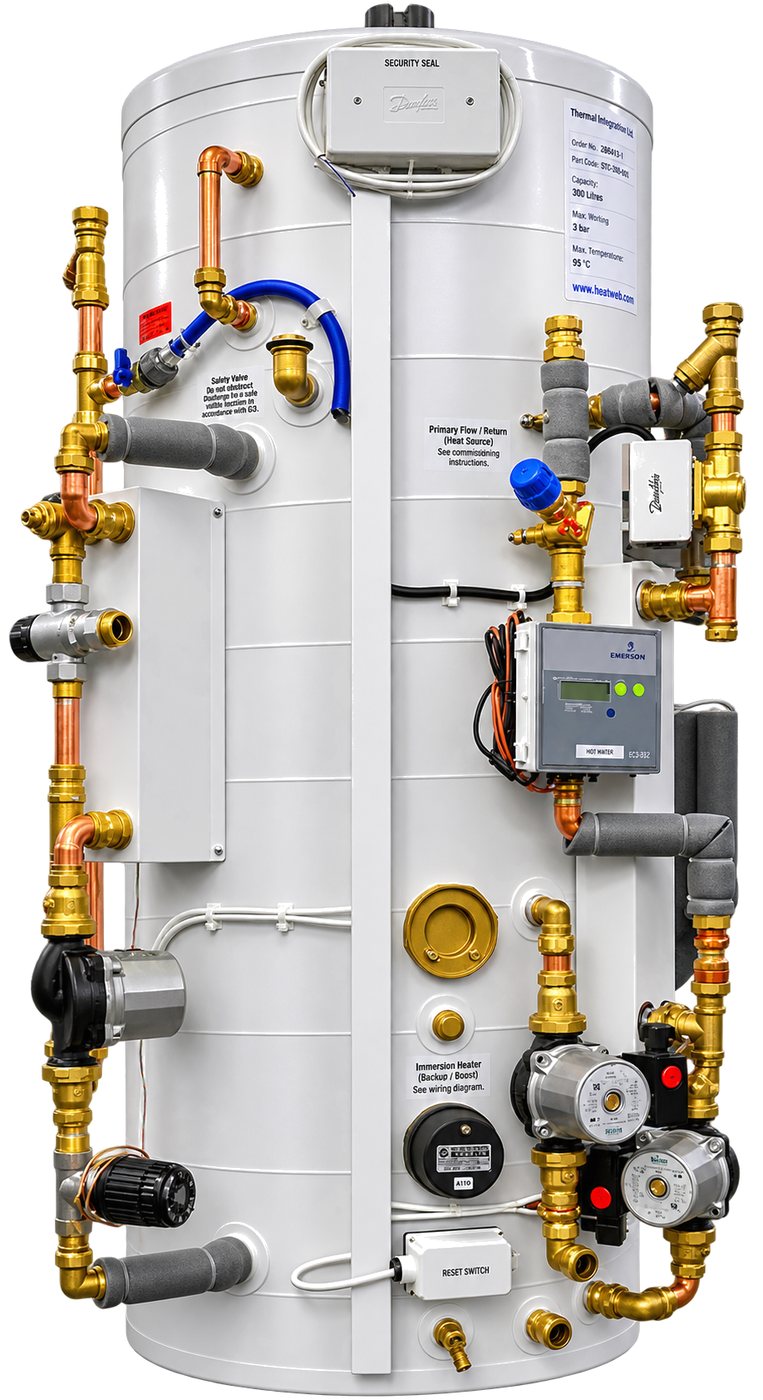
A multi-fuel system is easy to get wrong, and wood burner installations are among the most dangerous of all. So we never sold a HEATBANK as a bare tank. Every system was designed by us, assembled, wired and tested in our own factory, and supplied ready to connect.
- Design first. From 1998 our online System Designer took customers and installers through the property, hot water and heating needs and the heat sources, checked that the system would work, and produced the calculations, parts list and schematic. Every design was kept online for the life of the system.
- Prefabricated. Over 50 standard assemblies for different boilers, heat sources and controls were factory fitted, wired and tested, so every installer and service engineer met a known layout with set documentation and spares.
- Trained installers. We trained installers in our own training centres covering biomass, wood burners, solar, heat pumps, thermal storage and safety.
- Backed for life. Systems were guaranteed to work as intended, with a lifetime warranty and technical support for the life of the system.
Through stove shops and renewable outlets
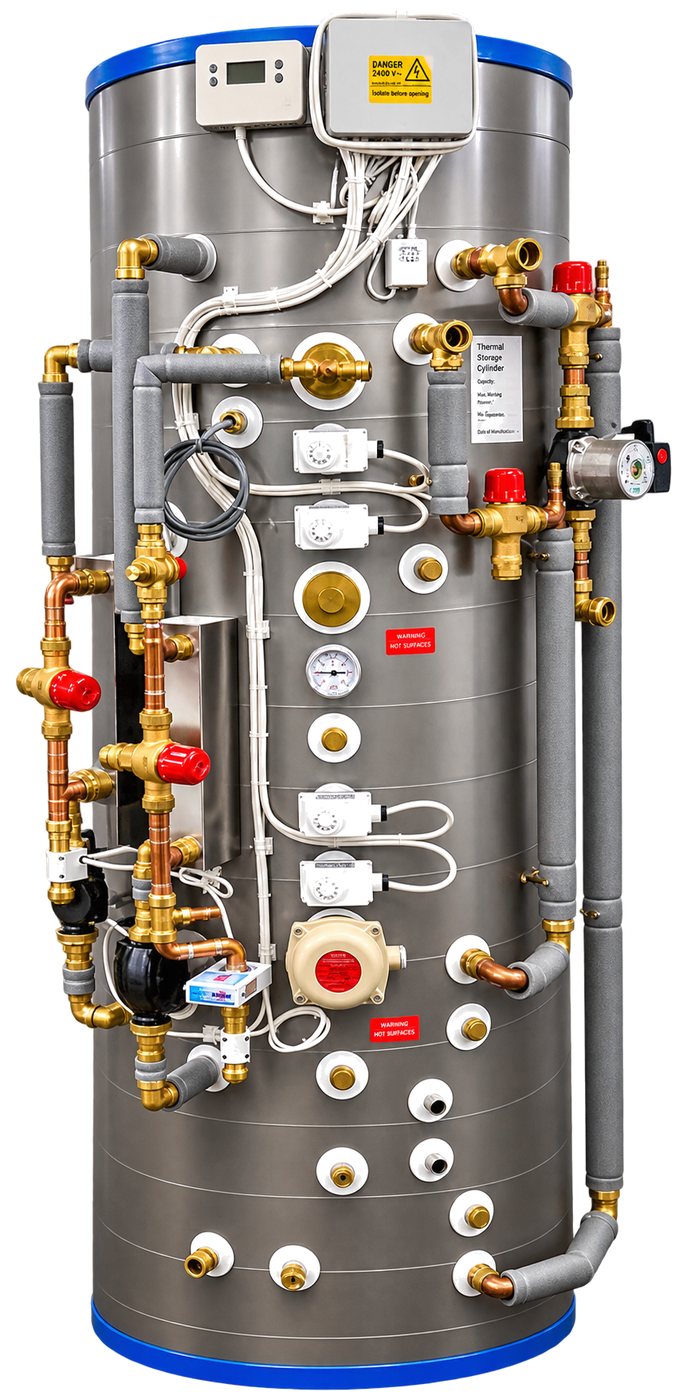
The approach suited the shops that sold stoves and renewables. At its peak the Xcel was sold through over 30 renewable and biomass outlets across the UK, many of them stove shops, most with a working HEATBANK on display beside the stoves and boilers it connected to. They could sell a complete heating and hot water system and know it would work, because the design was ours.
No discharge pipe: the PANDORA
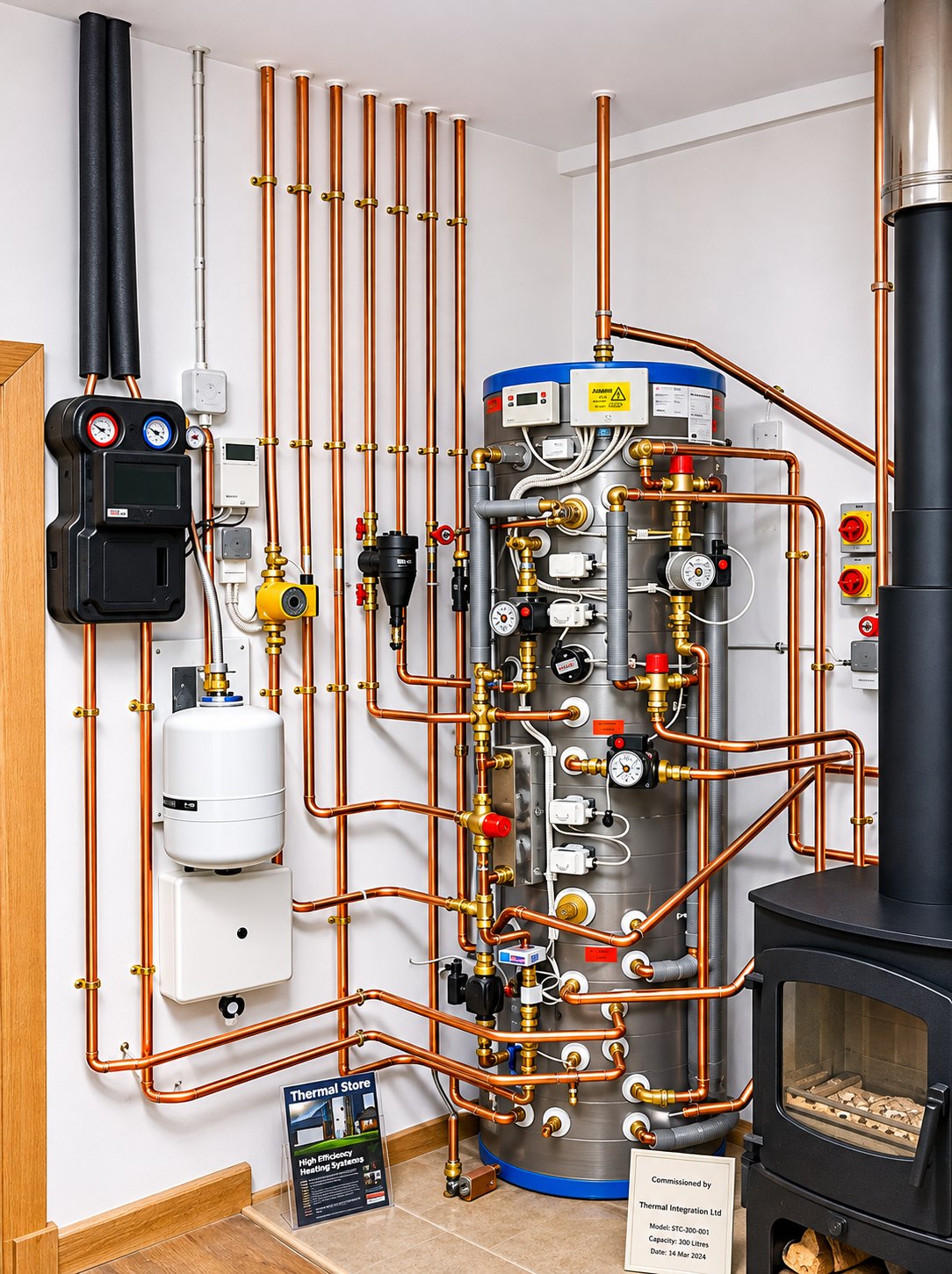
The PANDORA is an unpressurised thermal store that gives full mains pressure hot water through a plate heat exchanger, with no discharge pipe and no annual safety checks. That made it ideal for flats and high-rise buildings, where routing discharges is difficult, and it became our most successful product, with thousands supplied to local authorities and housebuilders.
- Electric versions heated by immersion elements: half the size of a traditional cylinder for more than double the output, typically installed in under an hour. One was among the first systems approved for an off-peak electricity tariff, carrying a home through peak times on stored heat.
- Indirect versions heated from a boiler through a coil, a favourite with large housebuilders for their quick installation.
- District versions connected to heat networks, for student halls and apartments.
At Queensland Road, Highbury we developed a customised slimline PANDORA with twin heat exchangers, 150 litres of stored primary water and electric backup to both hot water and heating. It was proven on a monitored test rig before WRAS approval, and we built and supplied 354 systems for the development, connected to a central boiler plant.
Storage on heat networks
Connecting stores to heat networks taught us what storage can do for a network. With heat stored close to the homes, a network no longer has to meet every shower as it happens. Our district HEATBANK design put 170 litres of primary storage near the point of demand: from a 24 kW primary input, about 7 litres a minute, it could deliver nine showers and two baths within an hour, four at the same time, enough for up to ten homes with diversity.
- Smaller pipes. Pipework is sized for the average load rather than the hot water peak, and the low return temperatures shrink it further.
- A network that can rest. Between peaks the network can go cold or run at weather compensated temperatures, with no keep-warm flow.
- Stores that work together. Controls let stores recharge in unison at planned times and prioritise those with the heaviest loads.
- Heat sources anywhere. With demand known in advance, heat sources can be plugged in at any point on the network and managed alongside the rest, instead of relying on central storage in the plant room.
From the late 2000s we fitted our own electronics to installed stores to log temperatures and energy flows, so that the next design was based on what systems actually did. That work led directly to the monitoring and controls we install on heat networks today.
Escape to the Chateau
When Dick Strawbridge needed a thermal store for his French chateau, combining two wood burners with a gas-fired range cooker, we designed and supplied a HEATBANK Xcel. Channel 4 then broadcast a series following the project, including the installation of our system. See Channel 4's Escape to the Chateau.
"After research, the best providers of thermal stores and the expertise to design the correct solution for our system was Heatweb Solutions."
The Chateau
More HEATBANK stories
- Reaping the rewards of renewable energy: a 495 litre Xcel combining a wood burner, solar panels and an oil boiler, saving 25 to 30% a year
- The HEATBANK comes to Anglesey: a ground source heat pump, two wood burners and solar panels on one store
- Vive la HEATBANK: a 275 litre Xcel, made to order, running a French cottage on wood, solar and electricity
- National Trust: Morden Hall Park: two 475 litre Xcels with solar, wood and heat pumps in a historic building rated BREEAM Excellent
- Queensland Road, Emirates Stadium, Highbury: 354 customised PANDORAs on a district heating network
Where it came from
The founder of the business had run cylinder manufacturing businesses that pioneered early coil-type thermal stores. The HEATBANK grew from replacing the coil with a plate heat exchanger, and from then on each generation was built on what the last had taught us in the field. Our thermal storage patents cover top-down reheating, overheat protection, hot water through plate heat exchangers and electric and district heat inputs. We wrote the sections on plate heat exchange and thermal storage in the Institute of Plumbing's Plumbing Engineering Services Design Guide. More on the patents: Heatweb patent applications.
Thermal storage design today
We no longer manufacture thermal stores, but the knowledge that made them work applies at every scale, from a cupboard to an energy centre. We design thermal storage for heat networks and for any system where several heat sources must work together:
- Sizing buffer and thermal stores against measured or modelled demand, with realistic diversity
- Connection layout and stratification, so each heat source and load works at the temperature that suits it and heat pumps and CHP run at their best
- Integrating heat sources: heat pumps, CHP, boilers, biomass, solar thermal and waste heat, on one network or in one plant room
- Controls: charging strategies, sequencing, return temperature limits and the use of storage to shift load
- Reviewing existing plant, where storage is often oversized, mixed or bypassed and costing efficiency
See also bespoke heat storage system design, Putney Plaza, where we upgraded the control of boilers, CHP and heat pumps around several buffer stores, and the buffer store control developed in our SBRI project.