
Download the final report (May 2023): summary, 23 pages (PDF, 2.8 MB) or the full report, 29 pages (PDF, 3.5 MB), which adds the exploitation plan, SWOT analysis and business plan.
The idea
Better control, more transparency and greater efficiency: our open-source plumbing controller connects to almost every HVAC sensor and device, and gives an open-source software environment for control and communications. The project took our Version 1 prototype, built from:
- hardware: a heat interface unit controller
- software: Node-RED
- communications: the open MQTT protocol
and developed it into a complete, certified product range with the software, cloud systems and community around it.
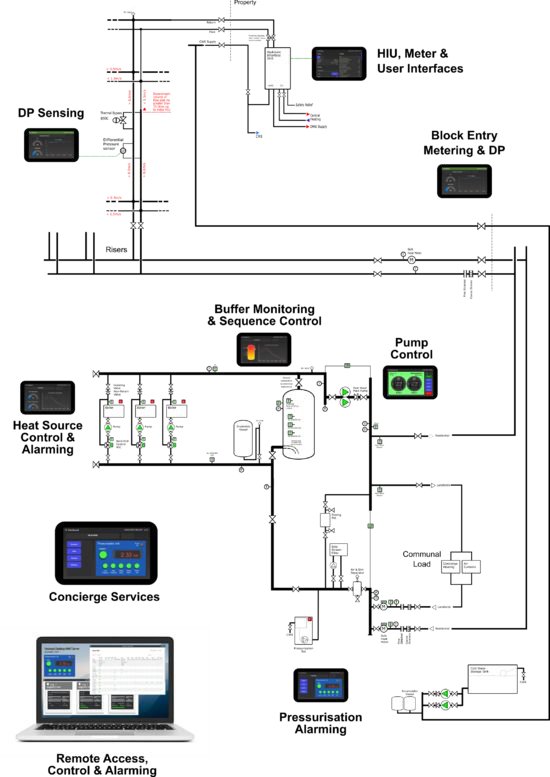
Hardware
The controller hardware has its own case study: the BEMS 2.3 controller.
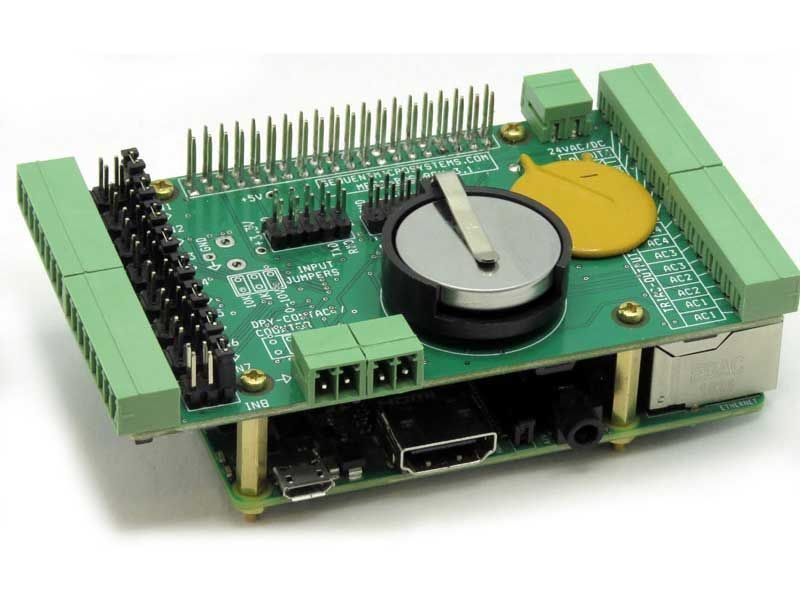
Plumbing controller I/O board (version 4)
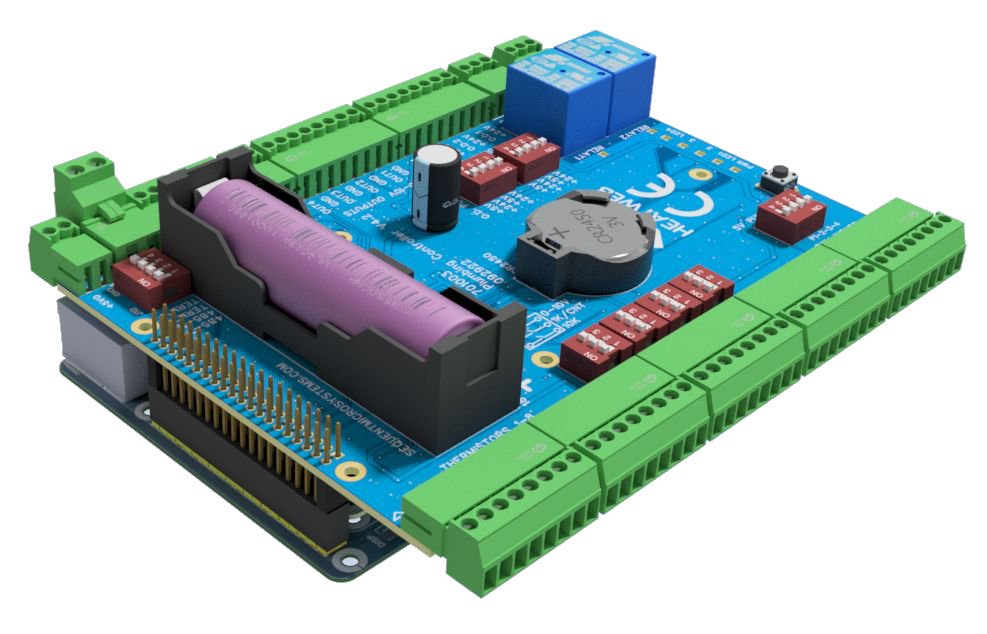
- 8 dedicated NTC temperature sensor inputs
- 4 universal inputs for volt-free contacts, 100 Hz pulse signals, 0–10 V signals and 1k/10k NTC thermistors
- 4 volt-free / 100 Hz pulse inputs
- 2 × 10 A change-over relay outputs
- 4 PWM inputs with jumper-switched pull-up resistors and voltage comparators
- 4 PWM sinking outputs with jumper-switched pull-up resistors, at both 5 V and 24 V
- 4 × 0–10 V analogue outputs
- 2 RS485 lines for Modbus or bespoke protocols, with jumper-switched terminating resistors
- on-board Modbus for daisy-chaining multiple I/O boards
- M-Bus meter communications
- an on-board, battery-backed uninterruptible power supply to all equipment
- real time clock, general-purpose input button and 3 user-definable LEDs
- fan control and connector
- runs from a 12 V supply, generating uninterruptible 24 V for valves, 5 V for sensors and 36 V for M-Bus on board
Controller boards
The main processor is the Raspberry Pi CM4 Compute Module: well developed, industrial grade, available in a range of memory and processor sizes, and with an advanced feature set. It sits in a controller base board that provides USB, Ethernet and display interfaces as standard, and talks to the I/O board over I2C and three UARTs.
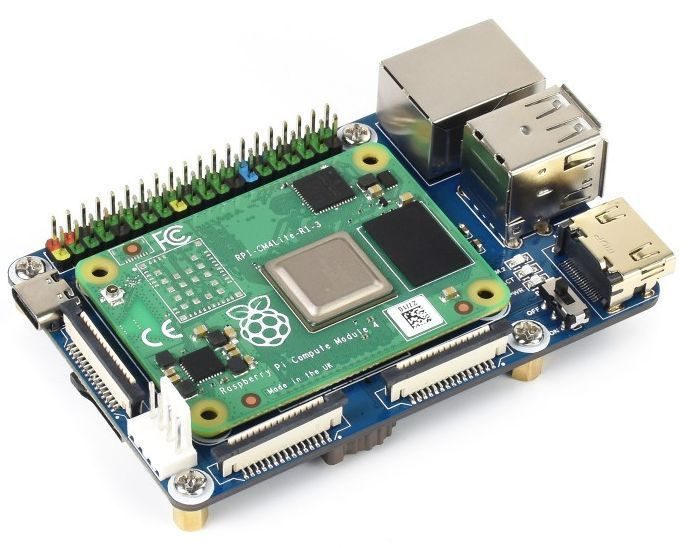
Every model of Raspberry Pi, the BeagleBone and the ESP32 are also compatible with the I/O board. Base board variants add communications options including GSM: a mini base board, a dual-Ethernet base board and our own ESP32 Raspberry Pi emulator.
Enclosure
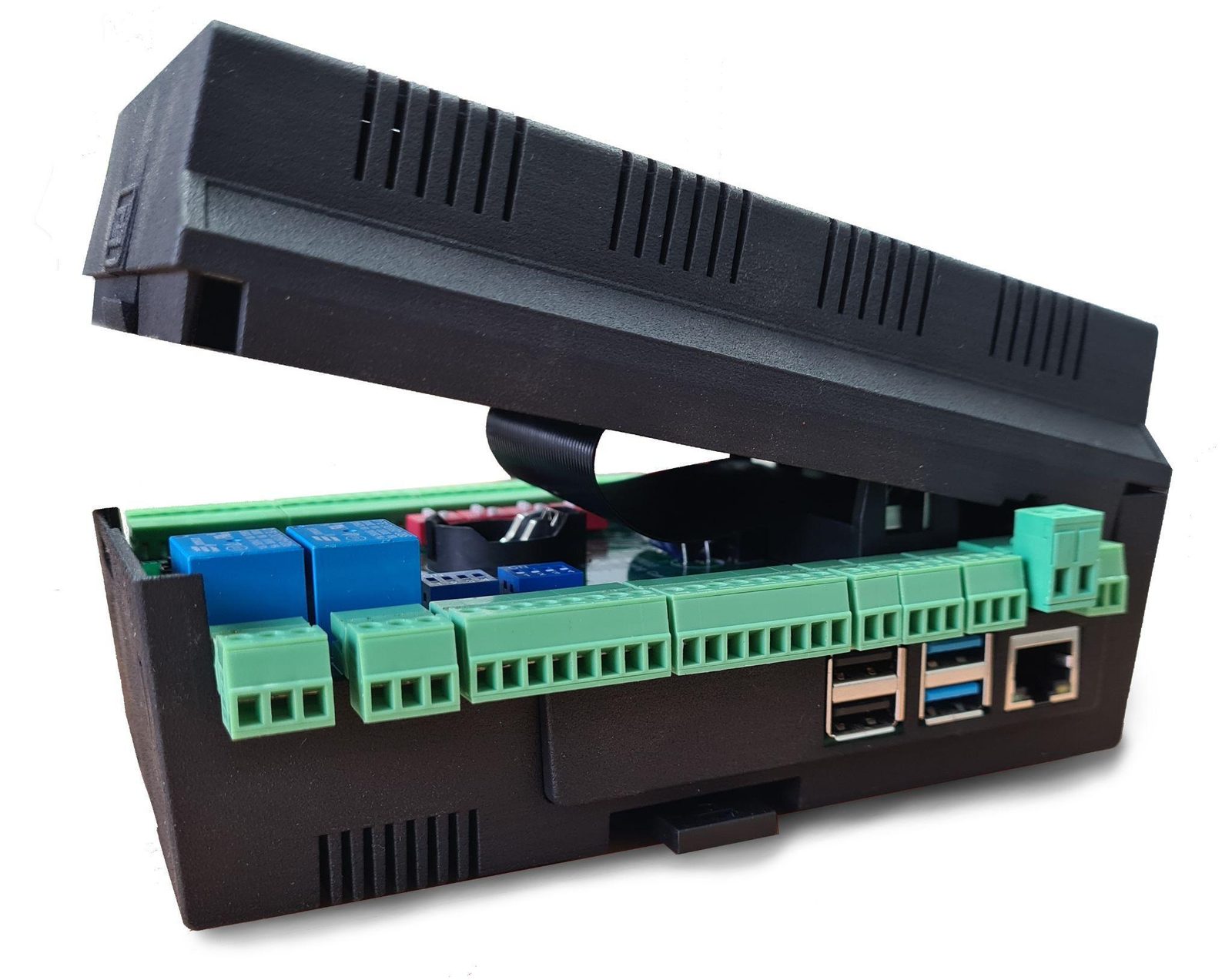
3D CAD let us model and assemble the controller in its final layout before production, and the enclosure went through two rapid 3D-printed prototypes to refine fit and function, with custom terminal labels for different applications.
CE certification
Every PCB developed in the project has been tested and found to comply with the EMC Directive 2014/30/EU: the heating controller (certificate POCE230403637TCE), the LCD display (POCE230403636YCE) and the ESP32 board (POCE230403635BCE). UKCA approval, with the same approvals body, is planned for future production runs.
A suite of products for each application
- Plumbing I/O board: plumbing I/O, 2 × RS485, M-Bus and battery backup
- BA board: 8 universal inputs, 4 × 0–10 V outputs, 3 triac outputs, 1-Wire and RS485
- EnOcean gateway and wireless sensors: Ethernet, WiFi, LTE modem, energy-harvesting wireless sensors for CO₂, temperature, humidity, volt-free contacts, CT current clamps and more
- Application enclosures: working control panels customised to the application, pre-wired, connected to the cloud and ready to turn on
- Control panels: standard and custom, in metal cabinets with touch screens
Software
Wiring editor
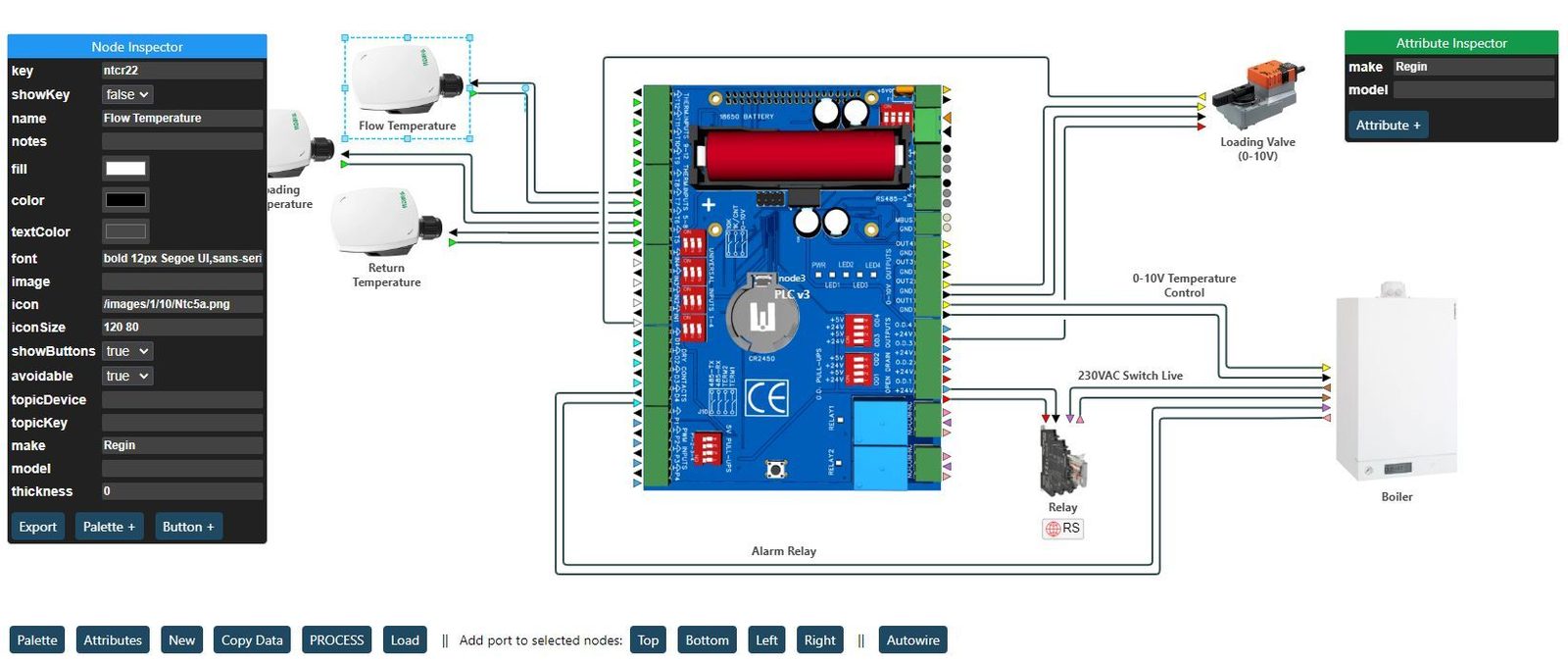
The project delivered tools that generate the application software from a visual wiring diagram, with drag-and-drop and automatic wiring.
An open-source controls stack
All the software on the controller is open source and licence-free, refined into a robust, modular framework built on proven core technologies:
- Docker containers for every application and service: easy to manage and update, version-controlled in public and private repositories, and isolated from the host system for reliability
- Node-RED for logic, control and data routing: completely open with extensive community support, a visual programming interface combined with code, and custom functions that can be refined and published as nodes
- MQTT for communications: an open standard used by millions of systems, publish/subscribe operation using topics and values to describe data, and fast and secure with built-in user management and topic rules
Getting started
Installing the open-source controls takes a single command from GitHub:
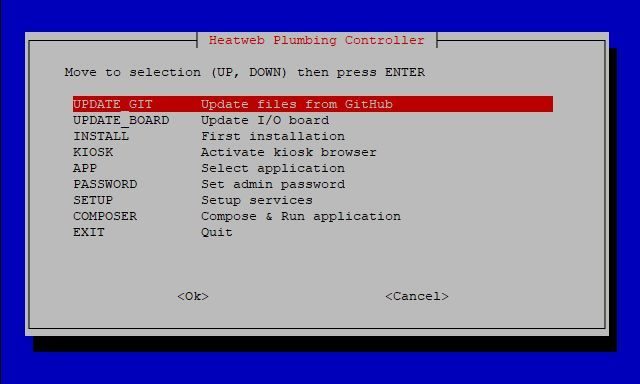
bash <(curl -sL https://raw.githubusercontent.com/heatweb/plumbing-controller/main/scripts/start.sh)A menu system, which can be run over SSH, then lets you install and manage services, update the I/O board firmware, build and update applications from Node-RED and Docker building blocks, and change the passwords on every service with one command.
Cloud systems
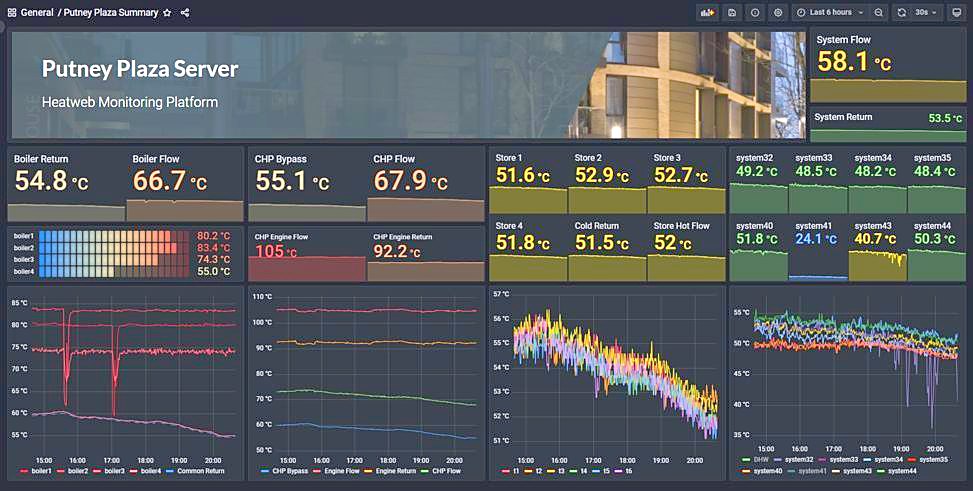
We designed and built an open cloud infrastructure around an InfluxDB database with Grafana for visualisation. The same components run in the cloud and in the controllers, so the architecture is the same everywhere. It can be run completely open source and licence-free, or switched to hosted commercial services where more support is needed.
The project established both routes: an open-source DIY on-ramp, and a fully hosted turnkey service on Grafana's infrastructure that meets the security standards and holds the certificates that commercial organisations and local authorities require.
Applications and field trials
Our focus was an open controls architecture able to run any HVAC application, licence-free, forever. To show how it applies in general, the project concentrated on three applications:
- buffer and thermal store control
- HIU monitoring and controls refurbishment
- fan coil monitoring and control
Each was demonstrated and refined in field trials, with controllers installed to monitor and improve real-world systems:
- The Barbican: cooling and heating circuits
- The Excel Centre: improving control of the air handling in the main halls (case study)
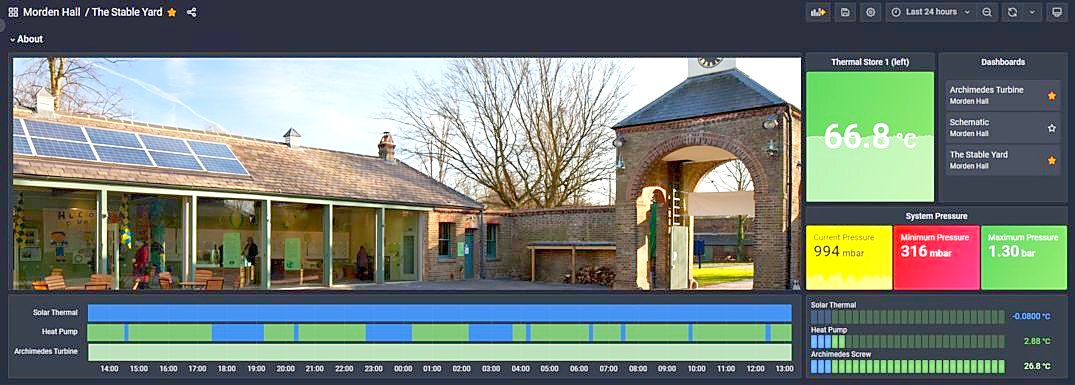
- The National Trust: revisiting Morden Hall, a BREEAM design using a mix of renewables including heat pumps and solar (case study)
- Swansea University SHED: the UK's first heat network driven by CO₂ heat pumps (case study)
HIU monitoring and control
We can monitor every type of HIU, from simple mechanical units to RS485-enabled electronic systems, and we also built a new HIU from scratch on our open-source hardware and software. Systems are GSM-enabled as standard, sending HIU data to the cloud database where performance is checked through statistical analysis, graphs and graphics. The controls enabled a new generation of hot water HIU with exemplary performance and reliability, remote commissioning and alarms.
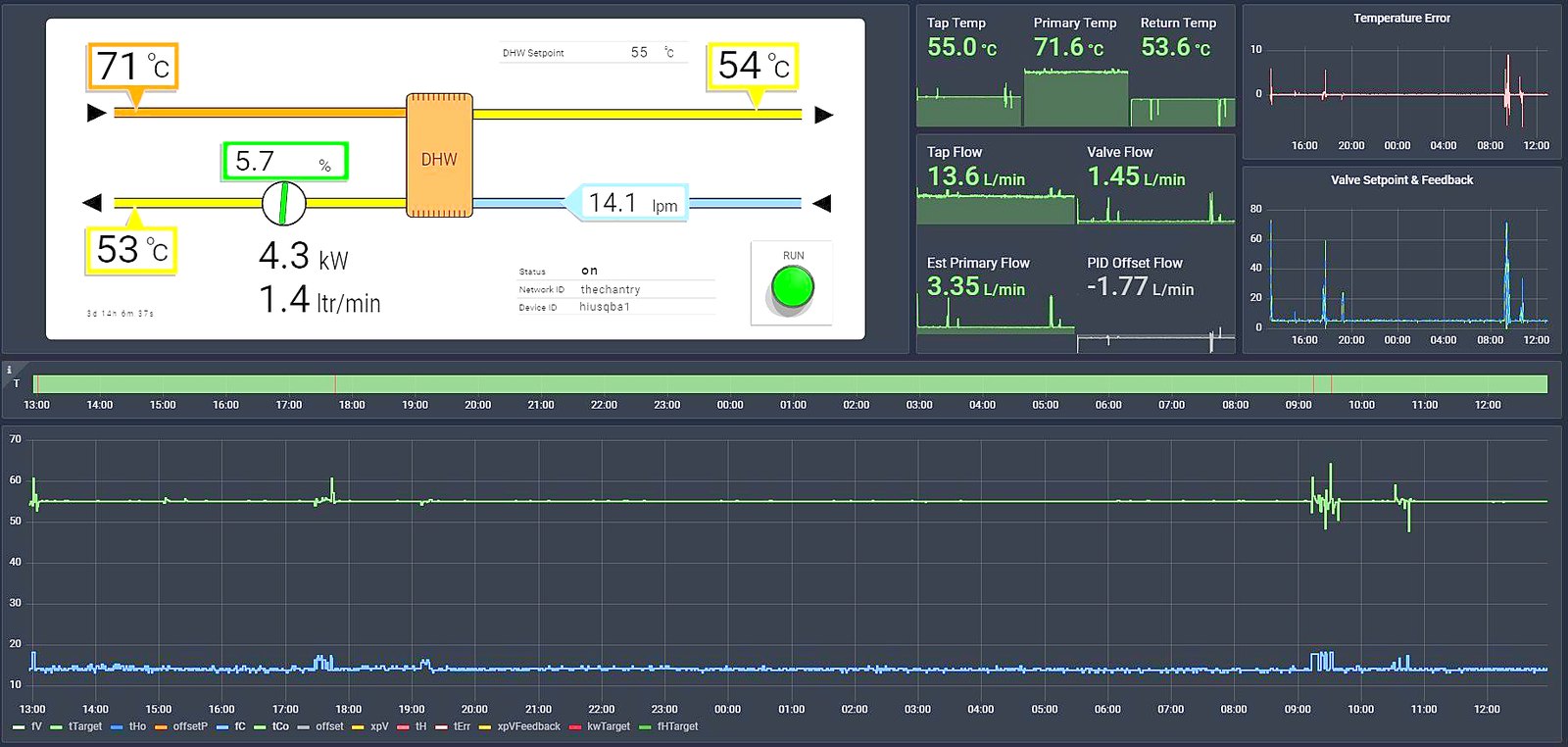
One deployment monitors all 147 HIUs for Thameswey Housing at Harrington Place in Woking, with service level calculations for every home.
Fan coil and air handling monitoring and control
Three field trials covered fan coils and air handling units, at the Barbican, the Excel Centre and the SHED: everything from domestic room temperature control to the largest exhibition spaces in the UK.
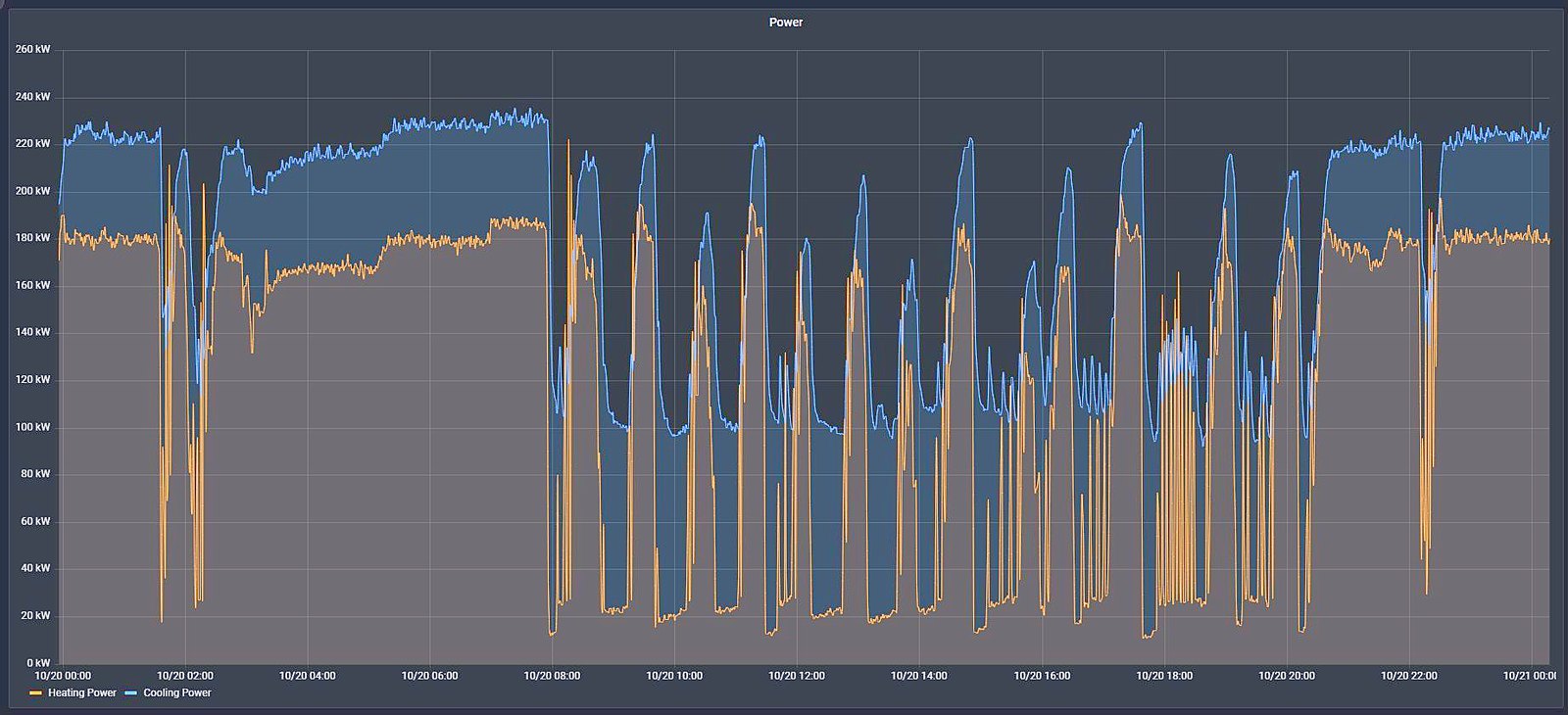
Adding basic visibility to existing systems produced some huge energy and CO₂ savings. The graph below shows a space being heated (orange) and cooled (blue) continuously at the same time because of a simple control error. It had gone unnoticed for years, wasting up to 400 kW, enough to power 100 homes. The estimated payback on the monitoring equipment was under 48 hours.
Buffer store control
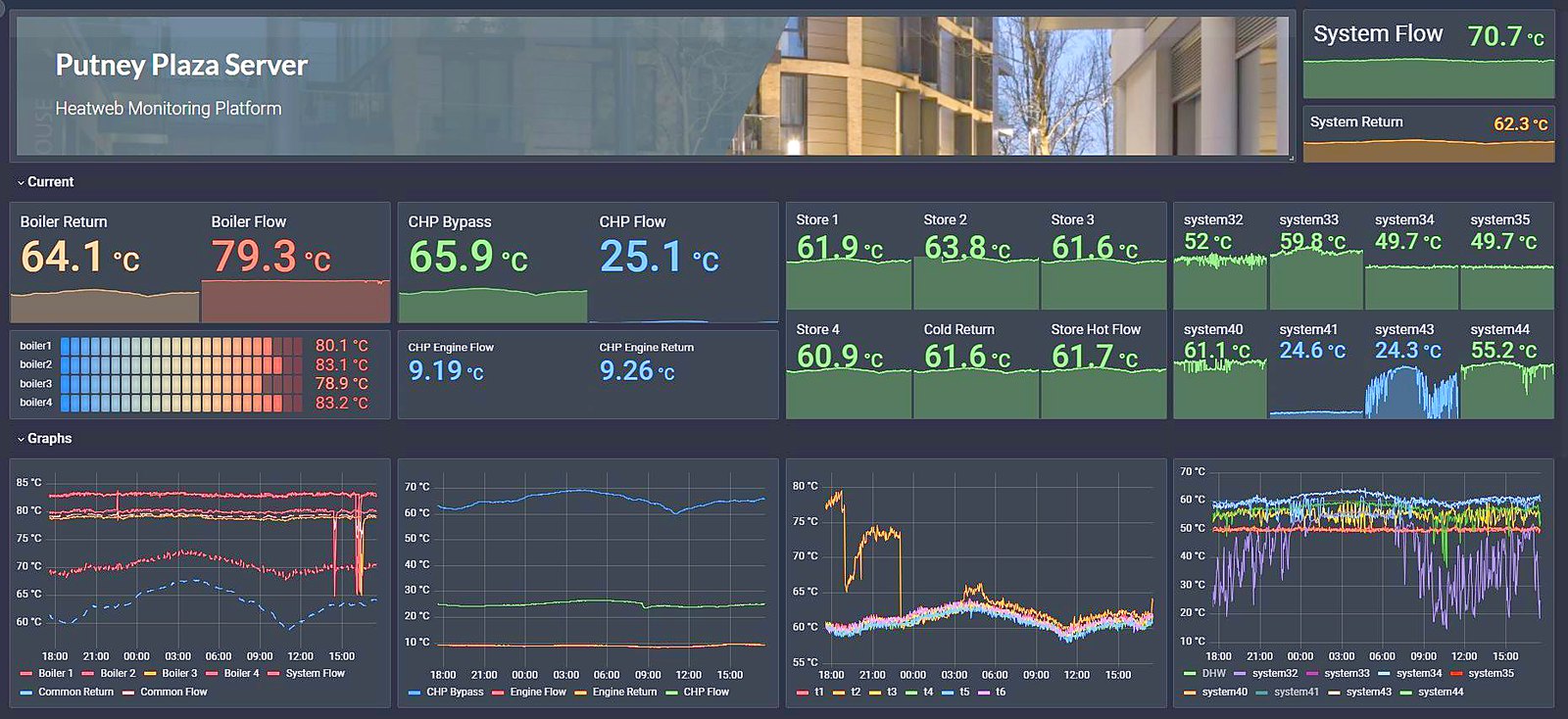
Buffer store control covers many functions, from simple heater control to boiler or heat pump sequencing. Applications are assembled from function blocks chosen at installation to give the combination needed. The Putney Plaza field trial, for example, upgraded the control of boilers, CHP, heat pumps and circulating pumps around several buffer stores and a common boiler header (case study). Other trials covered solar thermal and domestic biomass.
Bonus application: domestic energy, CO₂, temperature and humidity
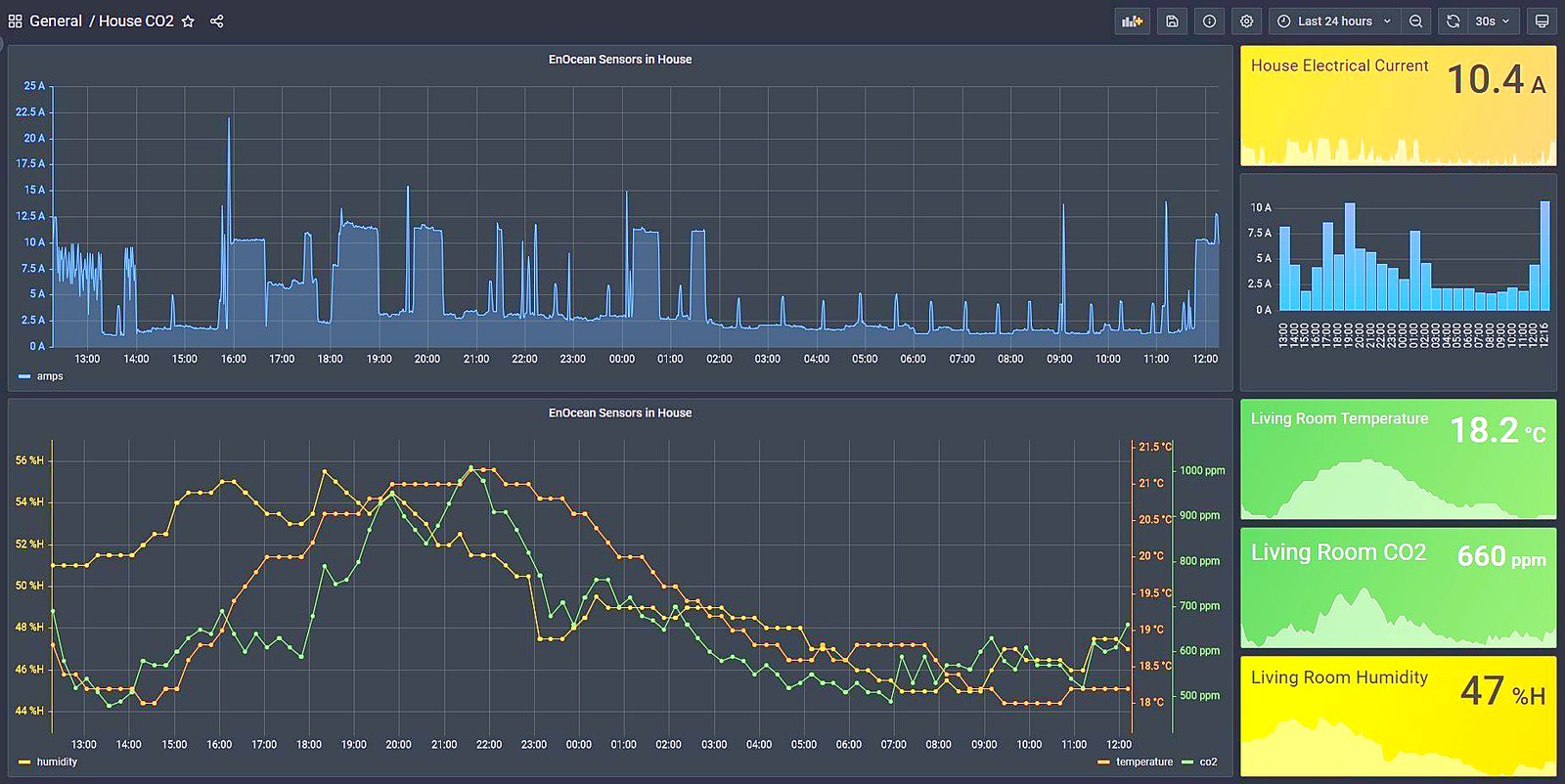
Wireless sensing installed in under five minutes gives detailed history of a household's electricity use, CO₂, temperature and humidity, so people can see where their energy goes and track how the changes they make save energy and improve air quality.
Bonus application: CO₂ heat networks
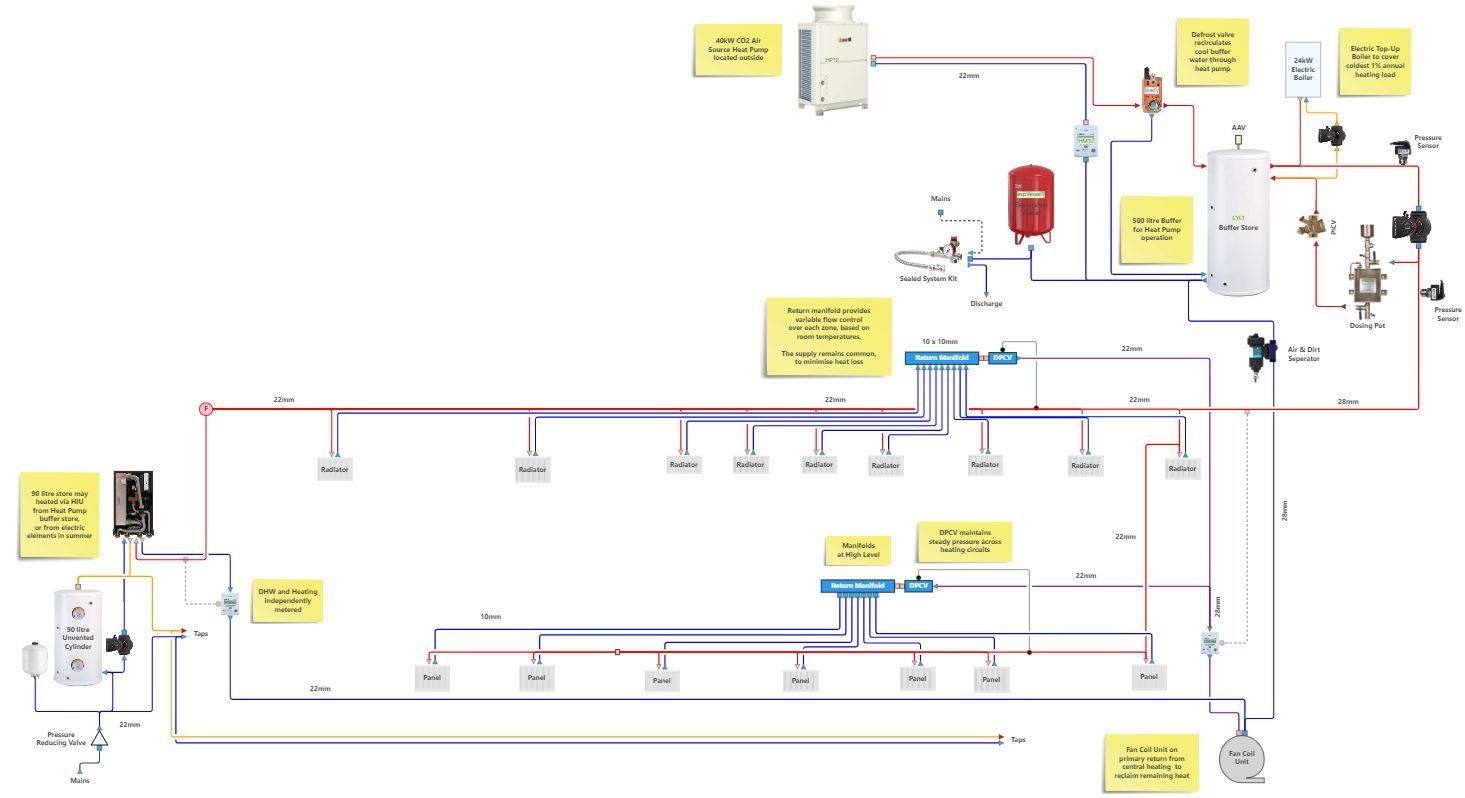
With Swansea University's SHED (Solar Heat Energy Demonstrator) we used the open controls to deliver the world's first heat network driven by CO₂ heat pumps, based on 40 kW heat pumps topped up by direct electric heating: using CO₂ to combat CO₂. The trial introduces a disruptive technology that significantly cuts capital costs, and nails down installation best practice along the way.
Open by design
Everything the project produced was recorded openly: software, hardware designs, instructions and field trial records. The aim was a community built around using data and open-source control to reach net zero, through a forum for newcomers to learn, follow others and find support, a GitHub project for the source code, and a wiki for media and reference material.
What came out of it
The project turned into the services Heatweb provides today:
- Open-source controls hardware: I/O boards and controllers, control panels and sensors
- HVAC and heat network optimisation: temporary monitoring, data collection, storage and visualisation, fault finding and reporting, and HNES technical assistance
- HVAC asset management: permanent monitoring and controls, a client portal with single sign-on, custom dashboards and reports, and alarms with escalation
- BEMS interventions: analysis of existing BEMS logic, remote access, revised control logic and data bridging
- Renewable consulting: revising hydraulic arrangements or designing new systems to integrate renewable heat, led by measured field performance, including CO₂ heat pumps, biomass and exergy-based network management
- OEM consultancy and support: for manufacturers and distributors of HIUs, substations and heat network equipment, including test rig design, control and commissioning, field monitoring, fault finding and alarm routing
- Data bridging and wireless sensing: routing signals between systems, and designing, installing and visualising wireless sensor networks