
Why it hadn't been done
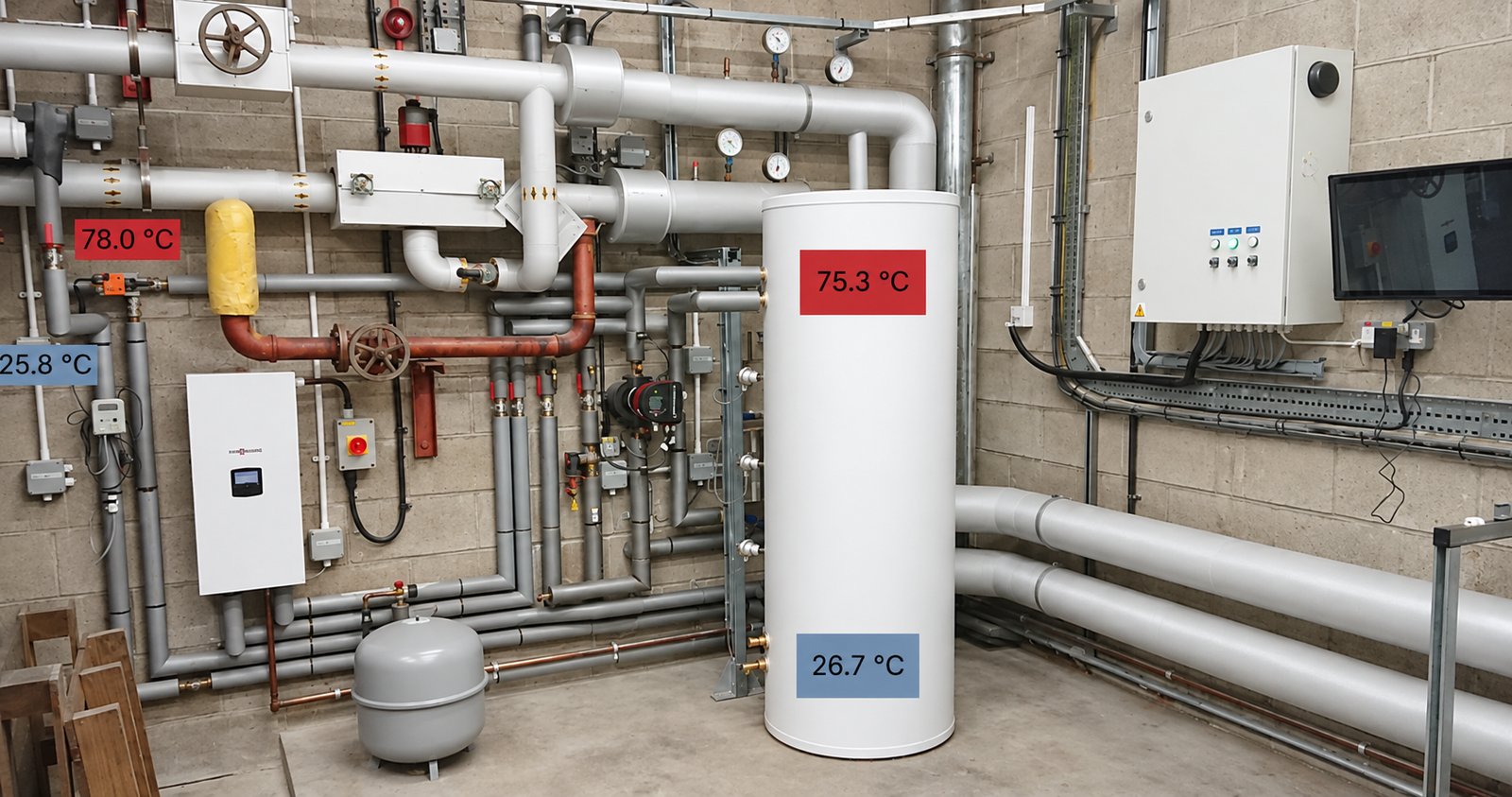
The CO2 heat pump on the trial, a Mitsubishi Electric QAHV, had until then only been deployed to make domestic hot water for taps, where there is a guaranteed large temperature drop. These units like a 30–50 °C drop, so an ordinary UK heat network, with drops as low as 3 °C, was considered incompatible.
What we set out to prove
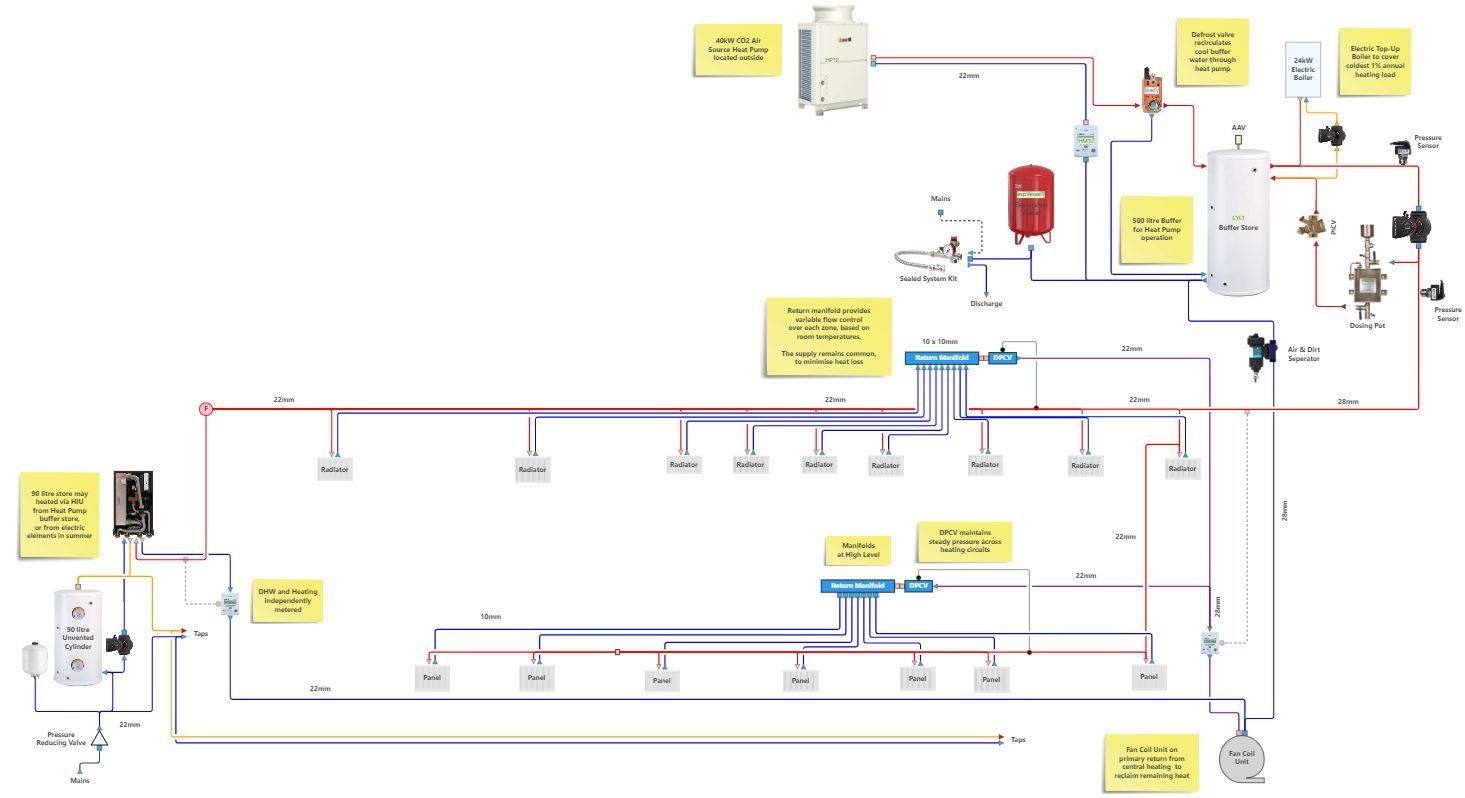
Heatweb designed the entire system, from heat source selection to pipe sizing, and supplied and commissioned the controls. All control on site ran on the new BEMS 2.3 controller hardware developed under our SBRI project to deliver open-source controls for net zero. Swansea was one of several final field trials, alongside the Excel Centre in London, the National Trust and the Barbican.
We know higher COPs are possible with other heat pump technology where the emitters and insulation suit lower flow temperatures. The question here was different: does CO2 have a place in refurbishing residential heat networks with a riser-top approach, without upgrading the properties beyond their radiator controls? Done that way, the cost could be under £5k per property with little or no network downtime. If it works technically, a block can go all-electric without major work in the homes or plant rooms, and the decision comes down to running costs and COP against capital cost. A field trial was needed to get real-world performance data.
We also wanted to remove the need for radiator balancing. Poor balancing is one of the biggest real-world obstacles to achieving high temperature drops on heat networks, and we believed that the right return temperature controls could replace the installer balancing process altogether, more effectively than ramping up training and quality control.
Results
- Early operating data showed a COP of around 3.2, with the network running 20 zones of central heating on a mix of radiators, ceiling panels and fan convectors.
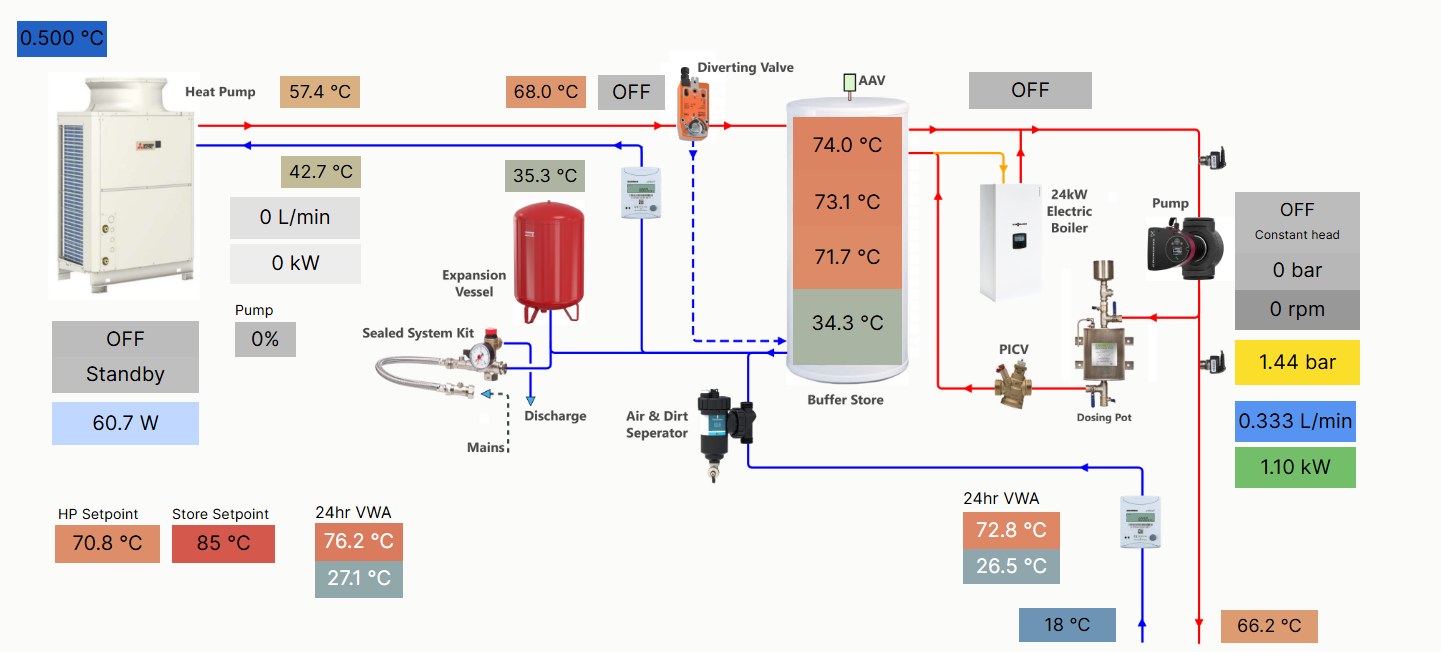
- Manifolds on the heating returns give room temperature control and return temperature limiting. With features such as setpoint ramping, they achieved a 24-hour VWART as low as 22 °C with a 63 °C flow, with no installer balancing or setup.
- Supply temperatures can be raised above 80 °C on the coldest days of the year, which allows far smaller pipes that keep minimum velocities all year round.
- Through the winter the system delivered heat to every room as required, and we were able to adjust the operating logic to hold service levels and maximise COP.
The trial's success led Mitsubishi Electric to warranty the QAHV installed in a primary system in this way, which opens the door to CO2 heat pumps on residential and commercial developments.
Key learnings
- CO2 heat pumps can work well on a heat network, providing the range of temperatures needed to drive standard-sized radiators through the heating season, alongside domestic hot water.
- Setpoint ramps with return temperature limiting give the best return temperatures while holding room temperatures. Turning the heating down at night with a slow morning start-up saves energy.
- Remote visibility, and the ability to adjust the control logic from what it shows, is critical to optimising a system.
- Radiators outperform every other emitter except underfloor heating, returning within a few degrees of room temperature.
- Fan convectors always trade fan speed against noise and efficiency. They look better on paper, but in an office or home the noise pushes them to a less efficient speed setting than radiators.
All the control logic used in the field trial has been published on GitHub under an open-source licence.