
The brief
The Excel Centre was one of the field trials in our SBRI open-source controls project.
The exhibition halls at the Excel Centre are heated, cooled and ventilated by large air handling units under the control of the building management system (BMS). Service levels are critical: exhibitions run live, and hall conditions have to stay within agreed limits. Any change to the controls therefore had to be fully explained and reasoned, with a real prospect of saving energy or improving environmental control.
The control targets were:
- reach hall temperatures within the required timescales
- hold hall temperatures at their setpoints
- cut the energy wasted through overshoot
What we did
- Installed Heatweb BEMS 2.3 monitoring alongside the existing BMS, combining data exported from the BMS with high-resolution readings from retrofitted sensors to fill the gaps.
- Captured and analysed the data continuously on an online dashboard, with traffic-light highlighting (red for poor performance, amber to look at, green for OK), so decisions rest on measured facts rather than guesswork.
- Reported our findings and recommendations to the client.
What the data showed
Operation was very similar from one day to the next.
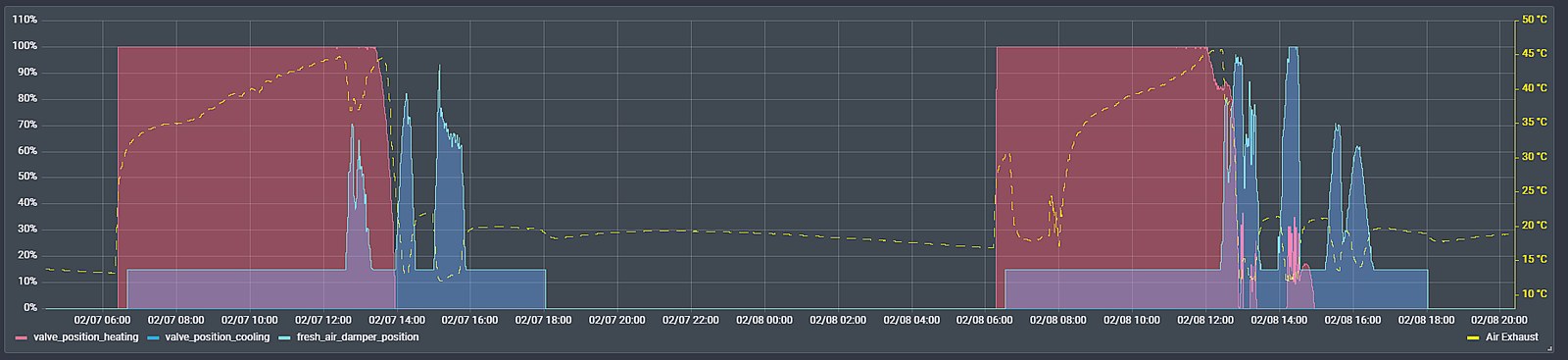
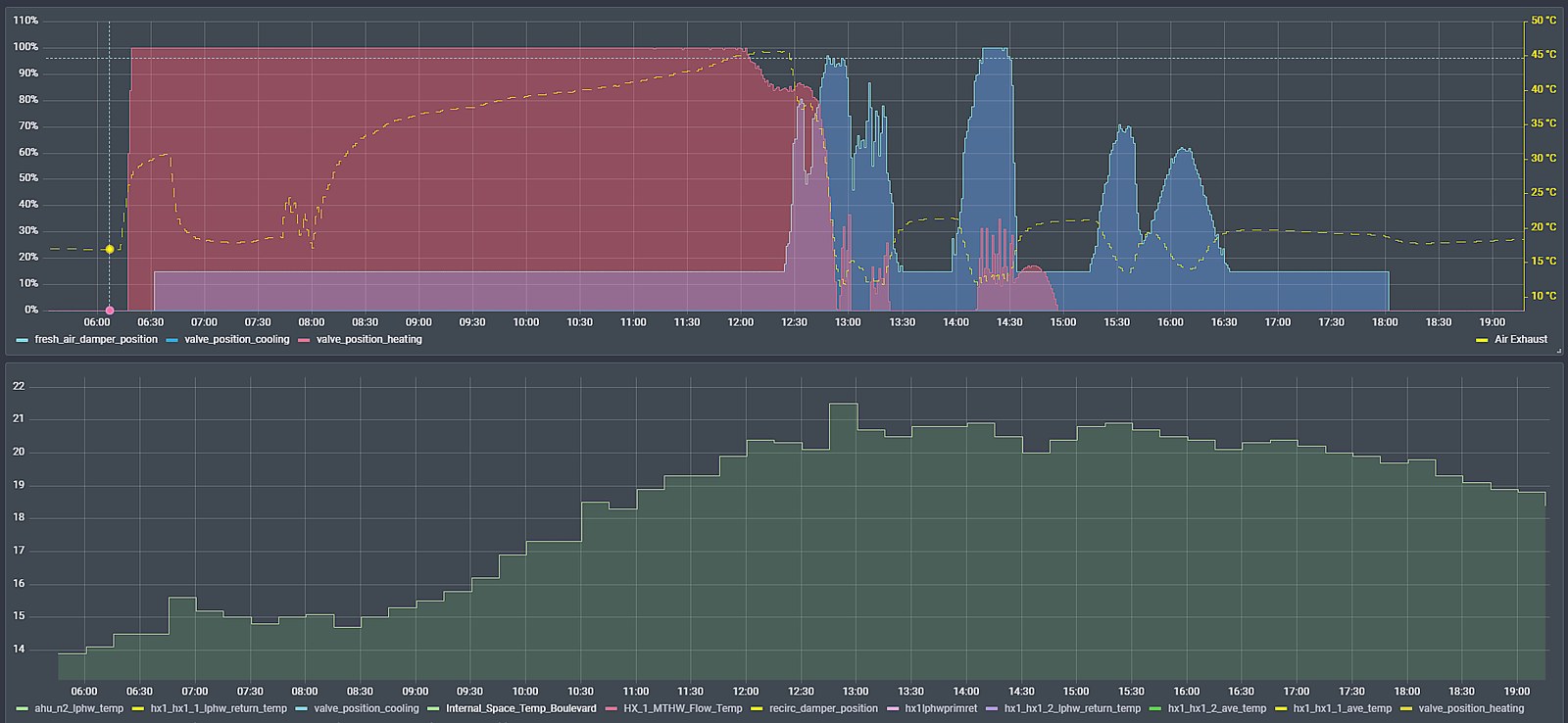
- The halls run to a 20 °C setpoint, but the proportional band is very tight and the control loop has no derivative (damping) response. Heat input stays at full load right up to setpoint, so the hall overshoots and immediately needs cooling.
- The system then swings from heating to passive cooling with outside air, and on to active cooling. Active cooling is rarely reached, but a lot of passive cooling is used to throw away the excess heat: in effect, heat is pumped outdoors.
- Cooling has the same lack of damping, so more heating is then needed straight away to counter the excess cooling.
- At times heating and passive cooling run together, competing. Fresh air should respond to air quality and CO₂, yet the cooling input was steady from start-up, only ramping up to reject excess heat.
What we recommended
A faster, cheaper start-up. While a hall is empty or lightly occupied there is no need for fresh air until CO₂ levels call for it. We advised bringing the heating on half an hour earlier, at 5:30, with the fans at 100%, and holding off cooling and fresh air for the first three hours unless CO₂ rises. Any fresh air needed in the morning is better done before the heat-up, and CO₂ levels and the control response should both be logged so the strategy is visible.
A smooth landing at setpoint. Without derivative control the BMS has no sense that it is approaching its target, so it never throttles back. The return temperatures from the heating coils showed when damping should have been acting: they climbed above 60 °C as the halls neared setpoint.
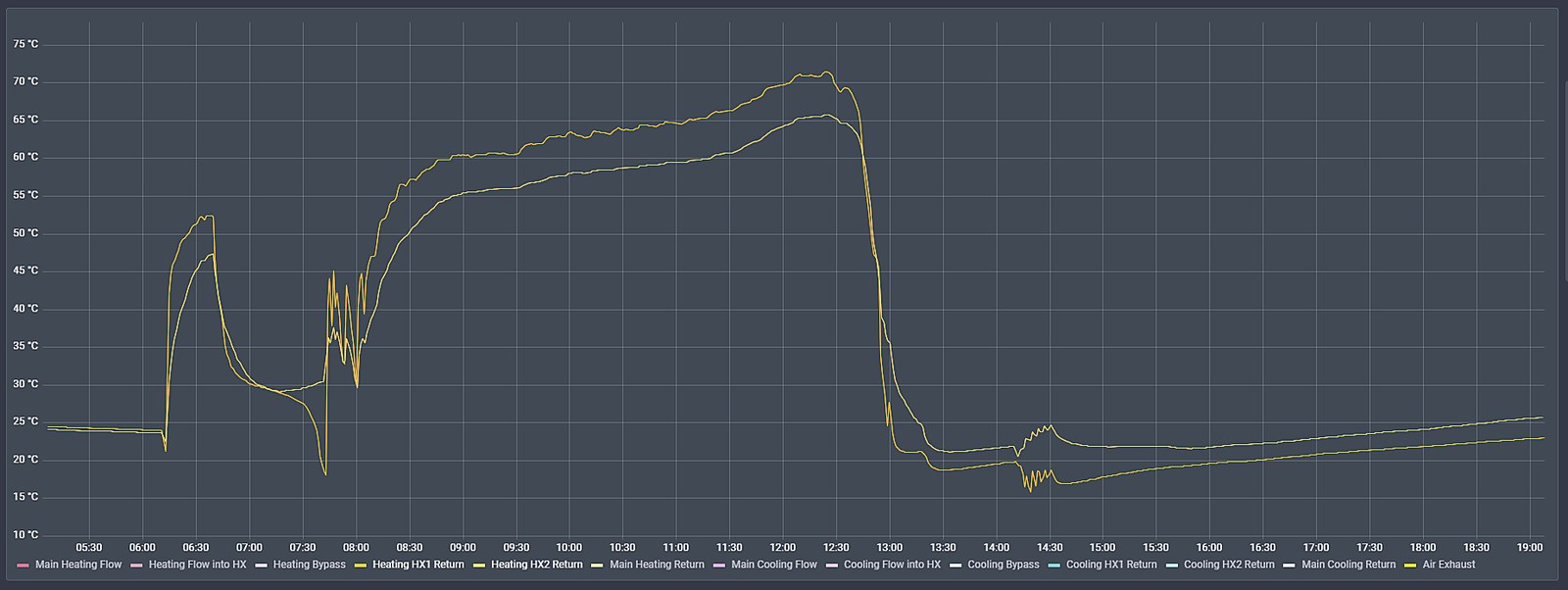
We proposed a return temperature limit within the existing controls: as the return climbs past 60 °C the valve closes progressively to hold 60 °C. This would come in at around 9 am, throttling back heat input as the hall reaches temperature, with fan speeds dropping back to 70% (sooner if air movement in the hall is higher than wanted).
Steady running for the rest of the day. From about 9 to 10 am the halls should settle into a steady state with two control loops:
- fresh air controlled to CO₂, settling at a background level that follows activity in the hall (a full hall, or one with animals, needs more), and used for cooling only when average temperatures require it
- hall temperature control running at a fairly constant rate of heating, or cooling in summer, in proportion to the outside air temperature, with a slower proportional response than today
Heat metering, so that energy use is measured directly, the value of each improvement can be quantified, and every change in strategy can be seen in daily energy use.
Control where it is needed. The Heatweb controller fitted at the air handling unit can monitor and control the equipment. Its inputs and outputs let it take over the control valves while still reading the existing BMS signals, acting as a transparent relay that passes the BMS commands through but adds logic where required. That opens the way to a full PID control loop of the kind used in heat exchangers, HIUs and substations, where accurate control is most demanding.
The result
The project showed how much is gained simply by setting up system controls correctly: efficiency improves with little effort and a significant return. With the data being collected, before-and-after savings are straightforward to calculate, KPIs can be added to the dashboard to track the savings achieved, and alerts can flag problems as they arise.