
At a glance
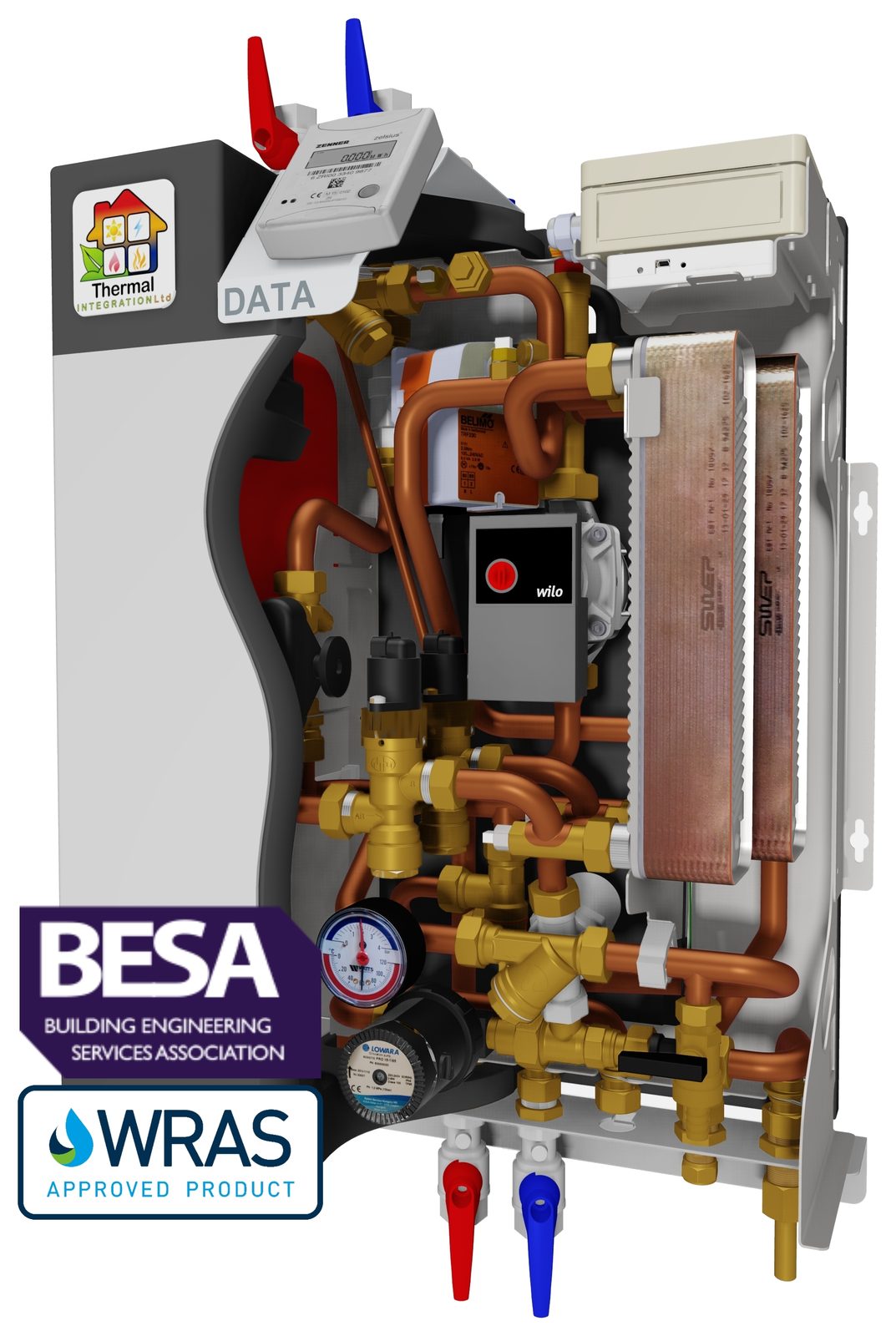
| Product | The DATA and DATA Plus twin-plate HIUs: instantaneous hot water and indirect central heating |
| Partnership | Heatweb design and specification; manufactured by HSF in the Netherlands |
| Independent testing | VWART of 15.8 °C under the BESA UK HIU test standard, the best result recorded |
| Hot water | Up to 65 kW (DATA Plus 75 kW), 45 to 60 °C |
| Heating | Up to 25 kW, indirect, 50 to 80 °C to suit radiators or underfloor heating |
| Standing heat loss | Under 50 W, in a moulded EPP casing |
| In the field | Supplied to UK heat networks for a number of years, on a control platform with over 20,000 units in service; Heatweb still services them |
The brief: an HIU that serves the network, not just the flat
An HIU has two jobs. The obvious one is hot water and heating for the home. The less obvious one is to return water to the network as cold as possible, because return temperature decides how efficient the whole network is: how much heat the pipes lose, how hard the pumps work, and whether a boiler condenses or a heat pump runs at a good efficiency.
When we started on the DATA, most HIUs did the first job and ignored the second. They were mechanical, with a thermostatic bypass in every unit keeping it hot around the clock, so every branch of the network stayed hot and returned water at 35 to 45 °C whether anyone was using it or not. Our aim was to design the HIU that would let a heat network run as close to perfect efficiency as the physics allows.
A partnership: our design, HSF's production
We brought decades of heat exchanger and hot water design to the DATA, and the control strategy behind it. HSF, one of the most experienced HIU manufacturers in the Netherlands, built it to our specification on its production lines, using hardware already proven in volume across Europe. That combination meant a new design without new reliability risks: every component had a track record, and what was new was how they were sized, arranged and controlled.
Why it was called the DATA
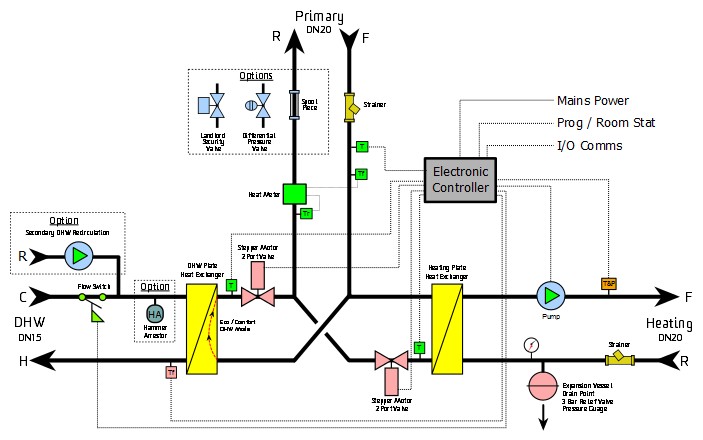
We named it the DATA because the design came from data, and the unit was built to produce it. Sensors on the primary, hot water and heating circuits let it measure its own flow, temperatures and output, detect faults and protect itself, and it could report every second to a network management system. That made every installed unit a source of field data on how real homes use heat and hot water, and that evidence went back into the design.
At Harrington Place in Woking, DATA and DATA Plus units in all 147 homes reported every second for more than a year. The data supported the UK's most efficient heat network at handover, with 28 °C return temperatures and the first live load shedding, and fed PhD research on how heat networks should be sized.
The design decisions
- Electronic control, one valve per heat exchanger. A mechanical HIU needs a separate device for each function. The DATA uses one stepper-motor valve on each circuit, and software does the rest: temperature control, differential pressure compensation, return temperature limitation, flow limitation, hot water pre-heat, heat-up boost, sterilisation and security shut-off. The hot water valve closes fully within five seconds of a tap closing.
- Heat exchangers matched to modern loads. Bigger is not better: an oversized plate heat exchanger runs laminar at low load and lets hot water straight through to the return. The DATA used asymmetric plates matched to the small heating loads of modern homes, able to deliver 3.4 kW from an 80 °C primary while keeping the flow turbulent.
- Heating that follows the network. The heating circuit tracks the network flow temperature and targets 5 °C below it, with no extra sensors or valves. The network can then run cooler in mild weather, cutting losses, while the HIU keeps its return temperatures low.
- Insulation that matters. The moulded EPP casing encases each component separately to stop heat bridging, keeping standing losses under 50 W.
- Settings locked in. Units were set in the factory to the consultant's requirements and confirmed at commissioning with a report. Nobody on site can open a bypass, override the hot water setting or turn the heating up too high, so the system performs in reality as it does on paper.
- Ready for metering and billing. Space for a heat meter and a landlord security valve within the casing, tamper-proof fixings, and communications for billing and BMS systems, remote commissioning and fault reporting.
Keep-warm: the strategies that changed HIU design
To give hot water quickly, an HIU has to keep heat close to the taps. The conventional answer was a thermostatic bypass in every unit, letting around a litre a minute of primary water through to the return at all times. That one design choice dominated the return temperatures, and the heat losses, of whole networks.
We replaced it with control. Instead of a constant bypass, the DATA pulses in a calculated volume of primary water every few minutes, too little to pass through the plate heat exchanger, so the heat soaks into the unit and the return stays at or below the hot water temperature. On top of that we added three ideas:
- Reduced comfort temperature. A keep-warm setpoint independent of the hot water temperature, so the main distribution pipes stay hot while the branches to each home settle at a much lower temperature, just above room temperature.
- Economy mode. Keep warm for a set time after the last draw-off, then let the unit go cold, coming up to temperature once a day for a 60-minute sterilisation cycle above 57 °C.
- Boost flush. When a tap opens, the HIU draws primary water at an increased rate (16 litres a minute as standard) until heat arrives. Combined with thermal bypasses at the ends of the risers, as guidance now recommends, this lets keep-warm be turned off in the homes altogether.
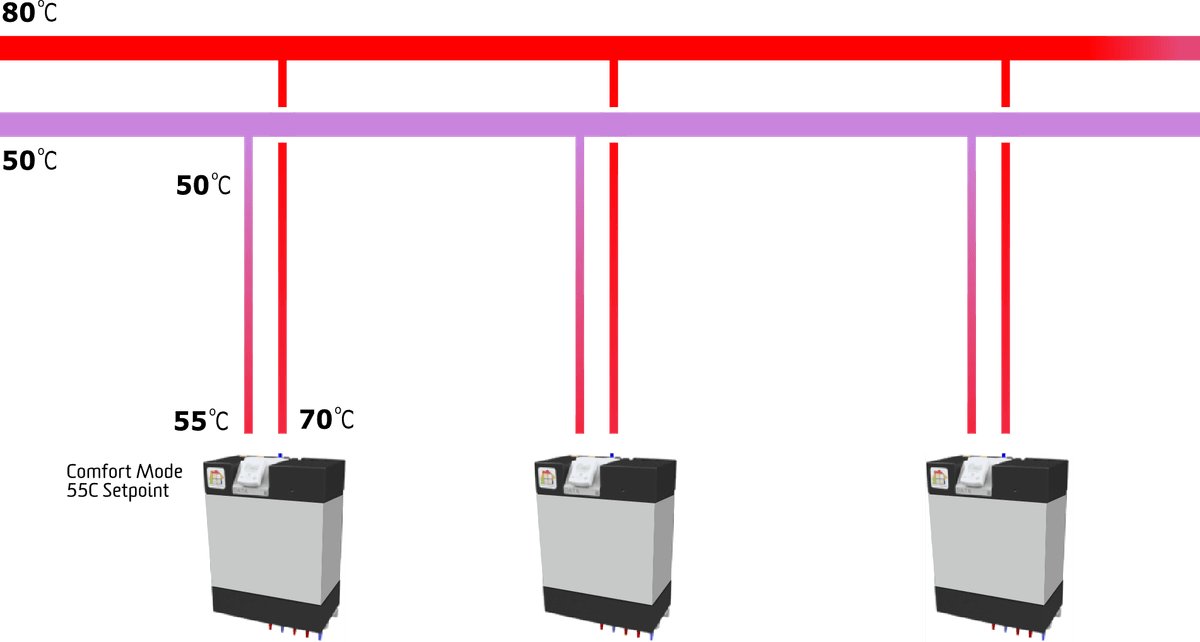
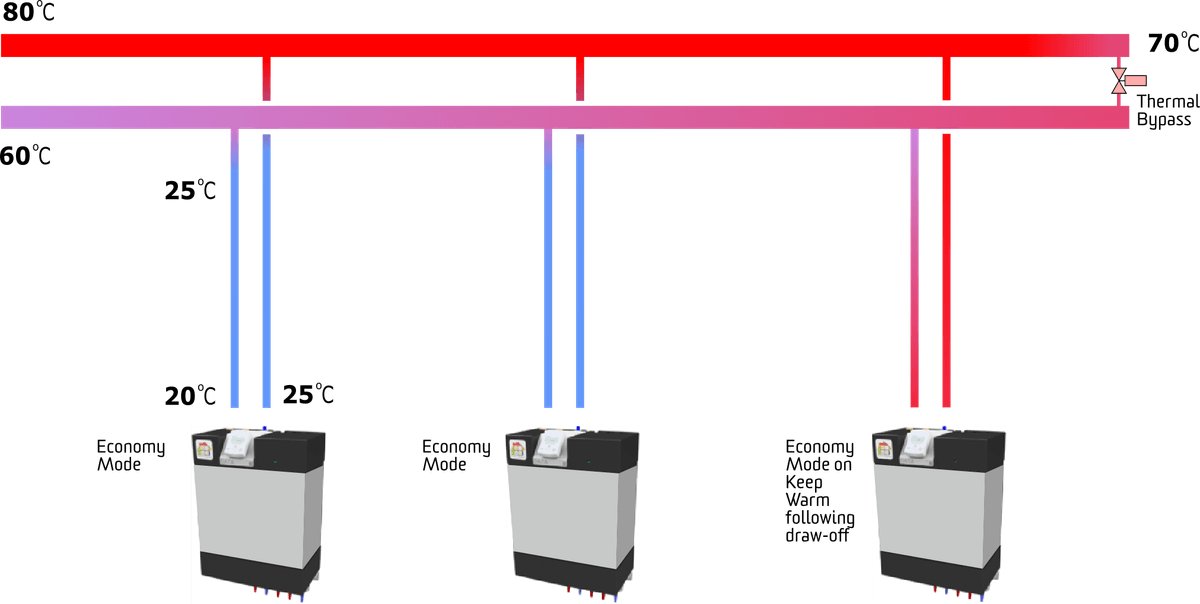
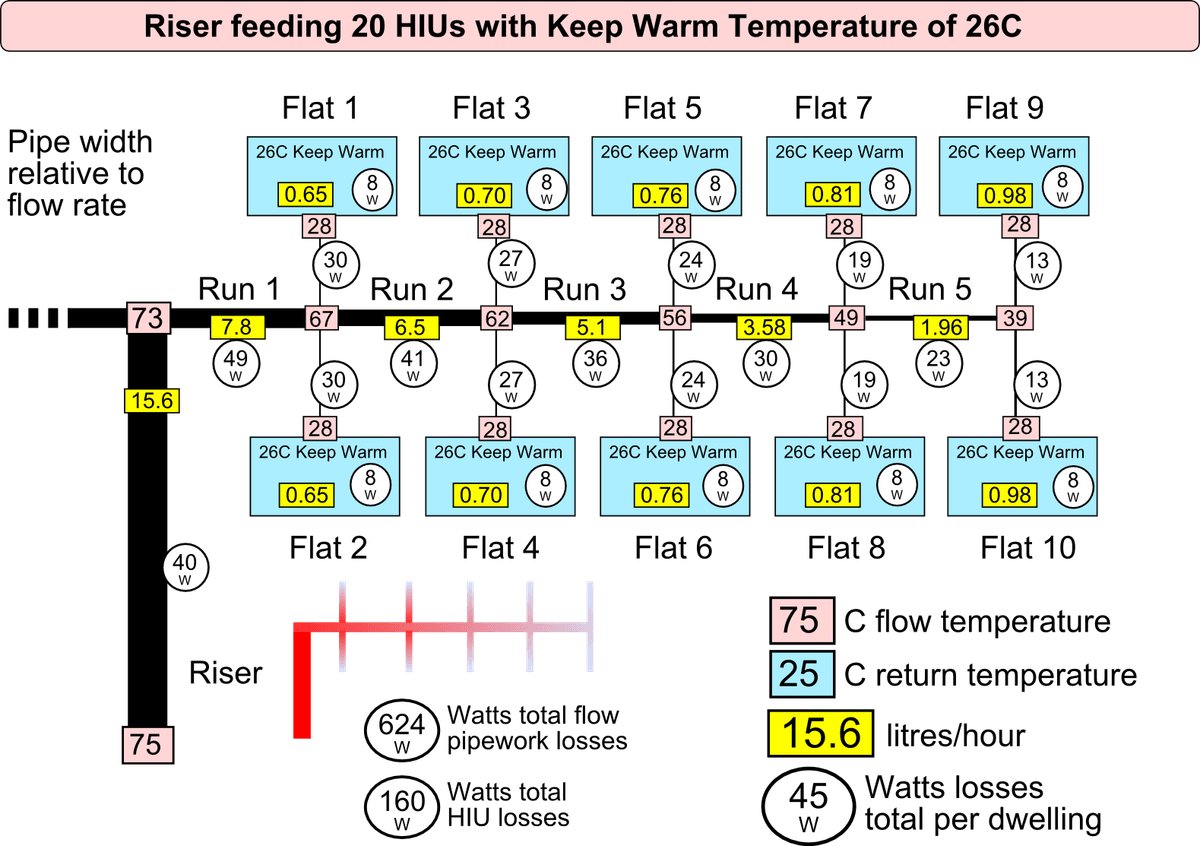
A riser of 20 flats with a reduced keep-warm temperature of 26 °C shows the effect: total losses of about 45 W per home, with branch returns of 25 to 30 °C.
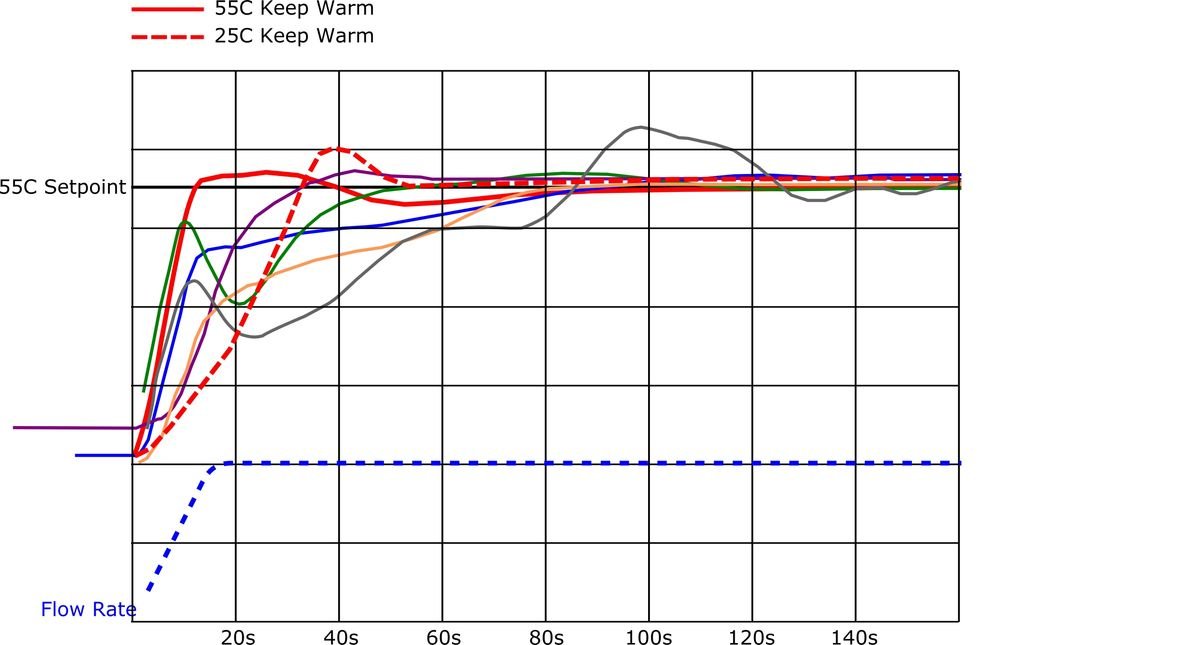
The lower keep-warm temperature costs very little in comfort. Hot water reaches its setpoint in a similar time from a 25 °C keep-warm as from 55 °C.
Timed and electronic keep-warm, separate keep-warm setpoints and thermal bypasses at the ends of risers rather than in every home are now common practice in HIU and heat network design.
Independent testing: the best results recorded
The DATA was one of six HIUs in the first independent tests to the new UK HIU standard in 2016, funded by government and carried out in Sweden. Among the twin-plate units it returned a VWART of 23.2 °C, against 29.4 to 44.6 °C for the others, and passed the least primary water above 20 °C: 77 m³ a year, against 117 to 168 m³.
Under the BESA UK HIU test standard that followed, the DATA recorded a VWART of 15.8 °C with no keep-warm, or 28 °C with keep-warm on (15 seconds delay). It is the best result recorded under the standard, and it held the top position for three years.
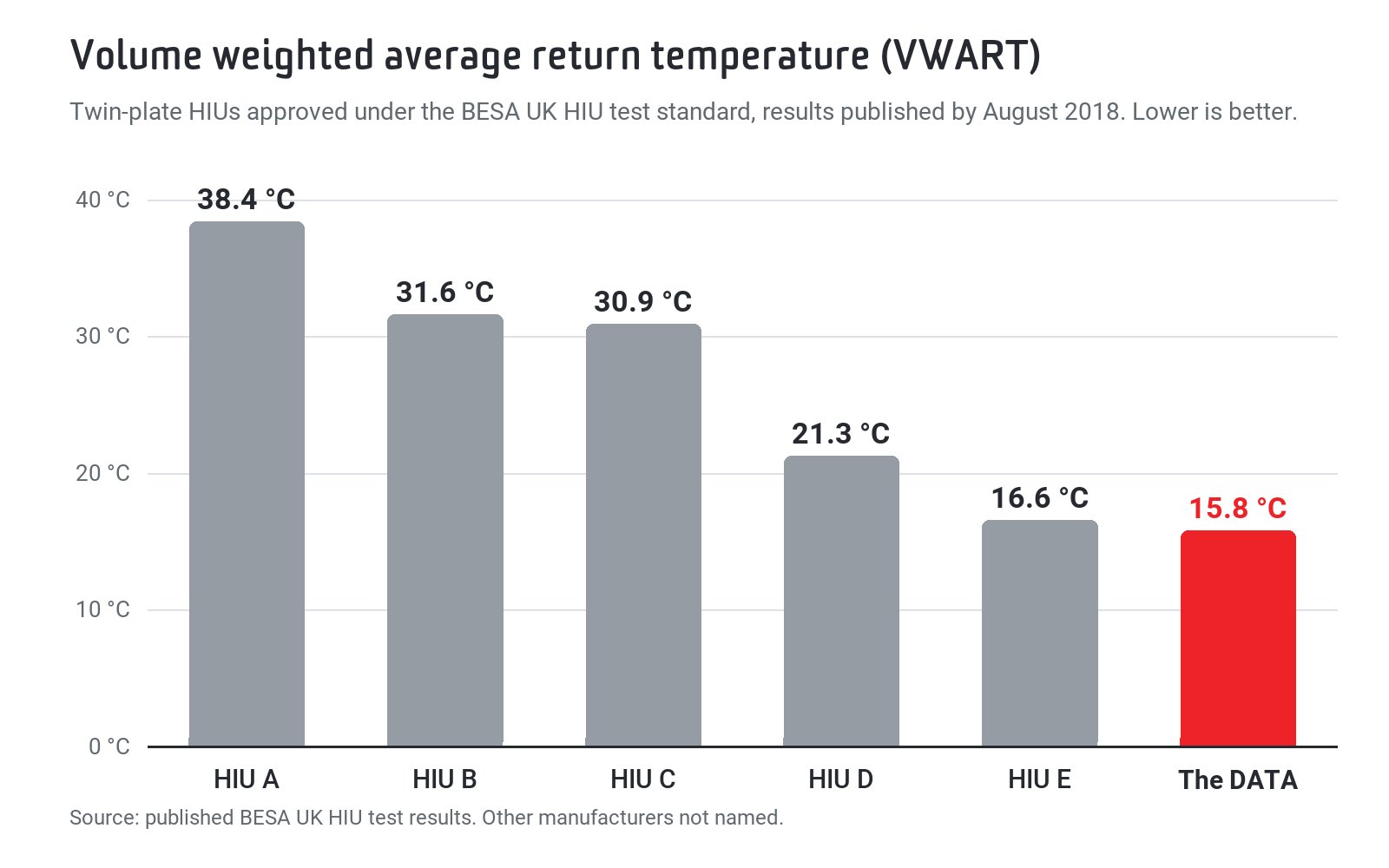
We published all the raw test data, so others could see how it was done.
Where it came from
The DATA was not a first attempt. The people behind Heatweb have designed heat exchange and hot water systems for more than forty years, and filed twenty-eight UK patent applications along the way: heat exchangers in 1983, mains-pressure hot water through plate heat exchangers in 1998 and 2000, combined hot water and heating apparatus in 2014, networked HIUs controlled as one system in 2014, and HIU communication over M-Bus in 2015. We wrote the sections on plate heat exchange and thermal storage in the Institute of Plumbing's Plumbing Engineering Services Design Guide. More on the patents: Heatweb patent applications.
The result
- The best VWART recorded under the BESA UK HIU test standard: 15.8 °C
- Keep-warm strategies that are now standard practice in HIU design
- An HIU that produced the data behind the UK's most efficient heat network at handover
- Units still in service across the UK, serviced by Heatweb today: see the DATA for support, spares and documentation
Working with manufacturers
The DATA showed what happens when an HIU is designed around the network it serves. We bring the same skills to manufacturers of HIUs, substations and heat network equipment: product design and specification, heat exchanger sizing, control strategies and firmware, test rig design and preparation for independent testing, and field monitoring of units in service to feed the next design.