
Useful Technical Data
Contents: Properties of Water Graph of pressure losses vs. flow rates
Properties of Water:
Chemical Formula: H2O Water molecules are made up of two atoms of Hydrogen joined to one atom of Oxygen.
Melting / Freezing Temperature: 0°C
Boiling Temperature: 100°C
Density: 1000 kg / m3 or 1 kg / litre This is a measure of the mass (weight) of a set volume of water.
Specific Heat Capacity: 4200 J / kg / °C This is a measure of the amount of energy, measured in Joules, required to heat water. 1 Watt = 1 Joule of energy per second 1 kW = 1000 Joules of energy per second
Often, energy is measured in kWhs 1 kWh = 3,600,000 Joules (= 3.6 MJ, 1 MJ = 1 million Joules)
Example: To calculate the amount of energy required to heat 100 litres of water through 10°C:
***Energy = Mass of water (kg) x Specific Heat Capacity x Change in Temperature *> Energy = 100 x 4200 x 10 = 4200000 Joules or 4.2 MJ
From this we can calculate the time it would take a 3kW heater to heat the water:
***1 Watt = 1 Joule per second *> 3kW = 3000 Joules per second
***Time taken (Seconds) = Energy Required (Joules) / Energy Input (Watts) *> Time = 4200000 / 3000 = 1400 seconds = 23.3 minutes
Note: It is very important to work in the correct units when making energy calculations.
Kv Pressure Loss Graph:
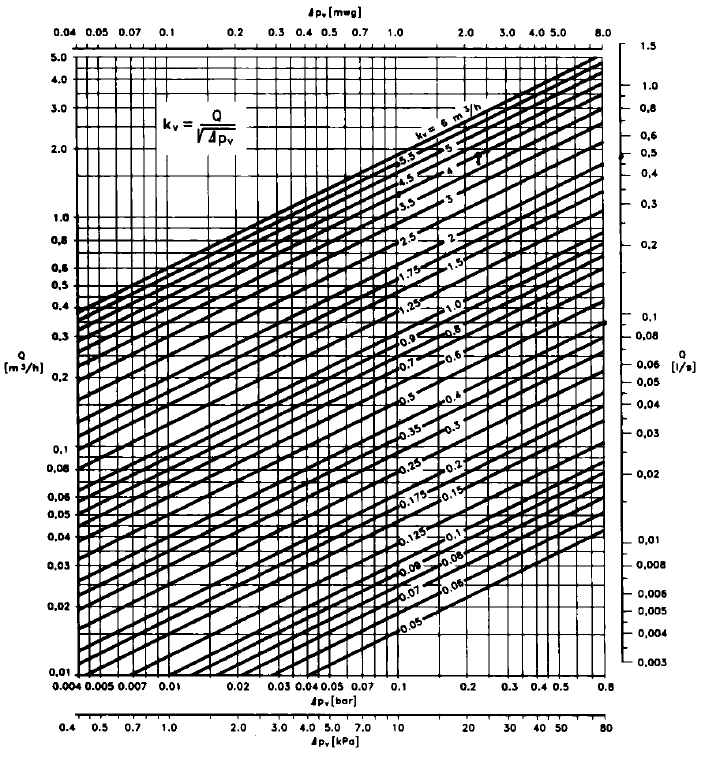
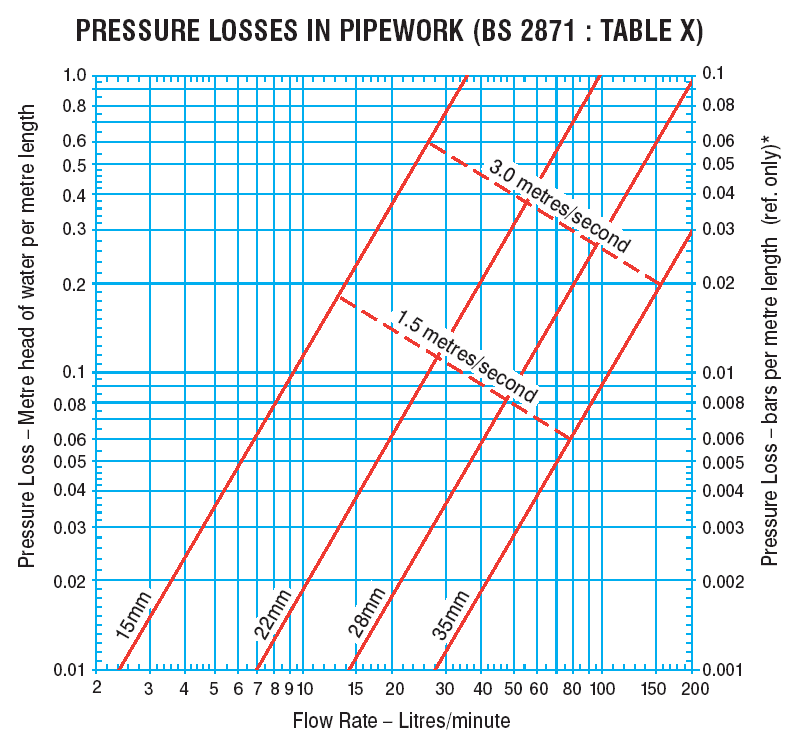
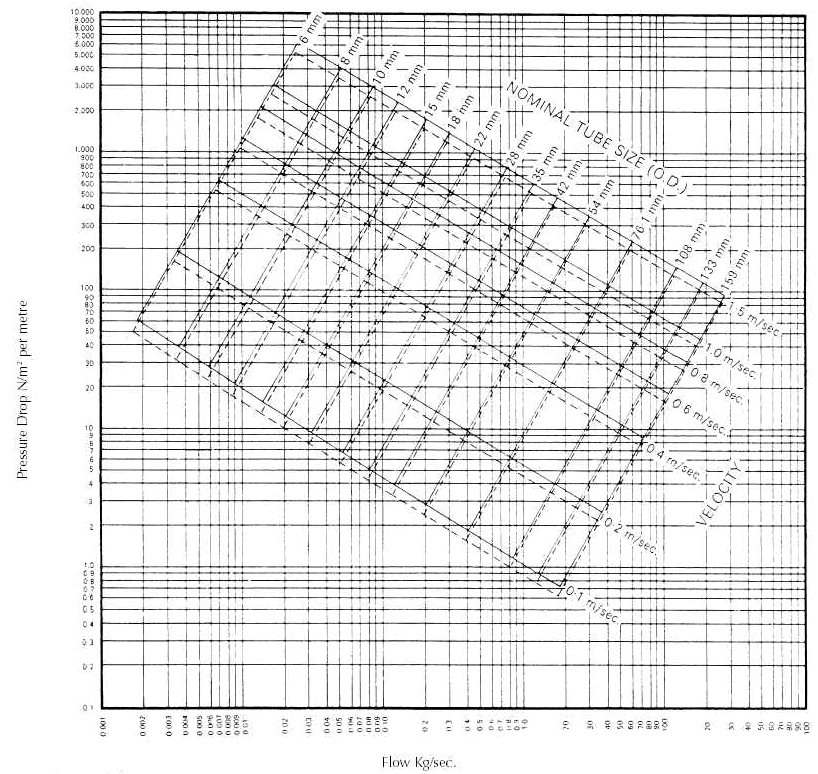
Pressure Losses through common Thermostatic Valves:
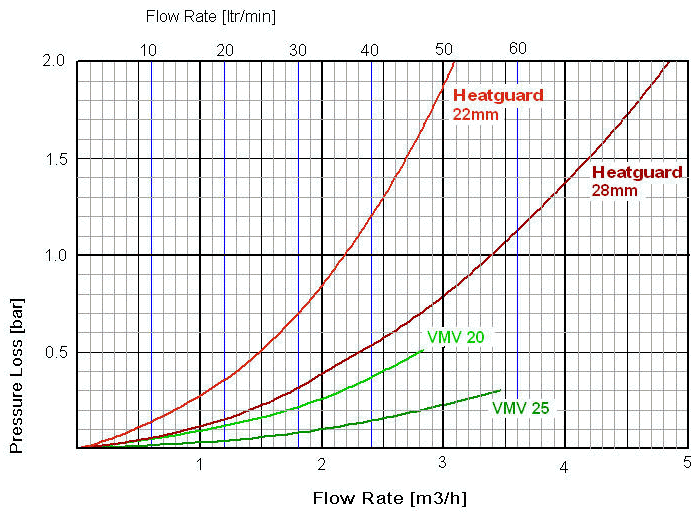
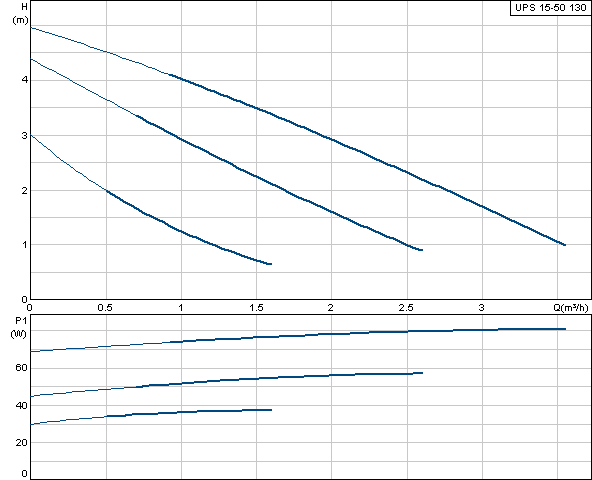
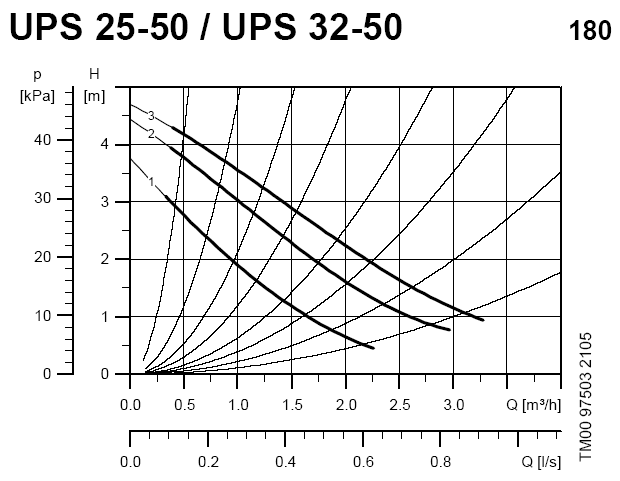
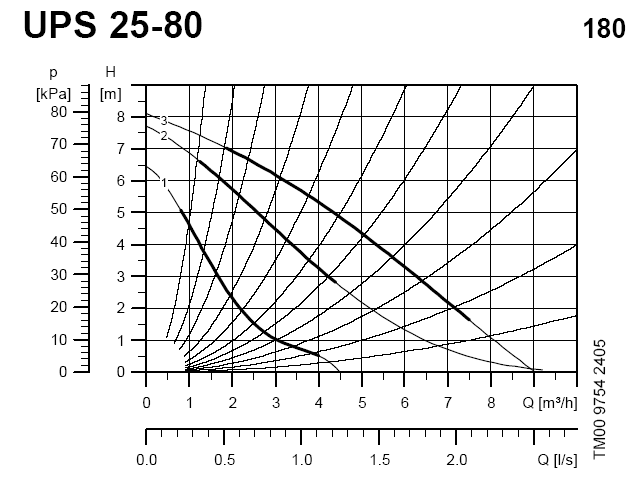
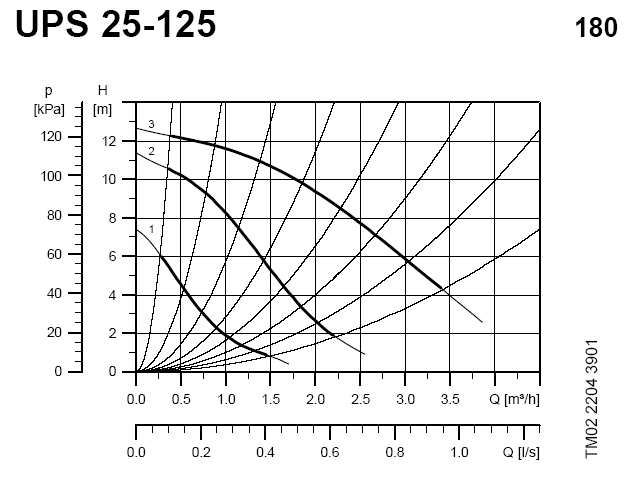
Pump Curves for standard domestic circulator 5m head:
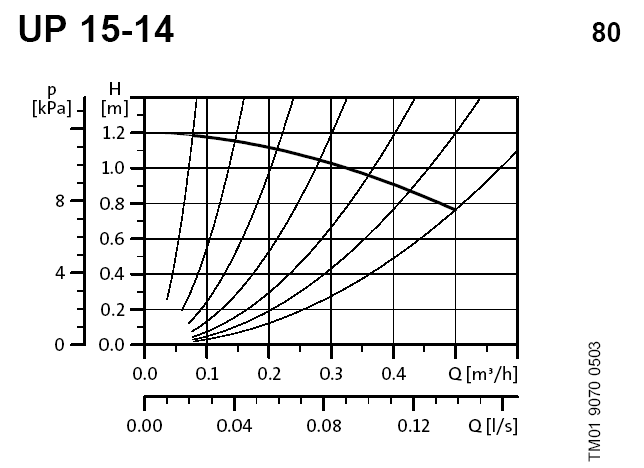
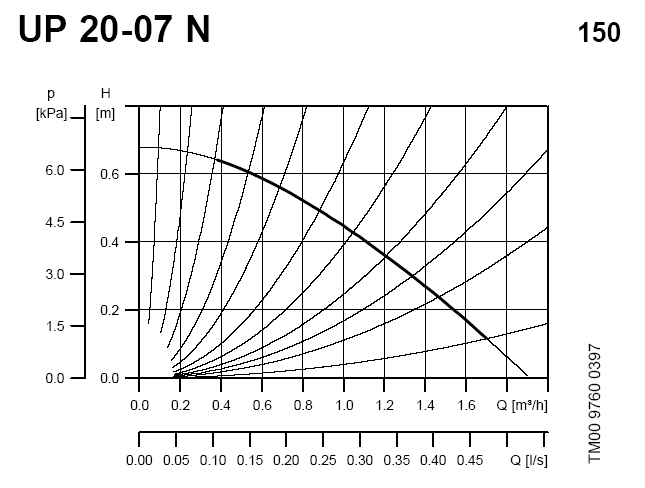
Conductivity and Density
Conductivity (k) is the ability to conduct heat through a material.
Heat Flow in Watts = (thermal conductivity) x (area / length) x (temperature difference)
Group
Material
Specific mass (kg/m3)
Thermal conductivity (W/mK)
Dry
Wet
Metal
Aluminium
2800
204
204
Copper
9000
372
372
Lead
12250
35
35
Steel, Iron
7800
52
52
Zinc
7200
110
110
Natural stone
Basalt, Granite
3000
3.5
3.5
Bluestone, Marble
2700
2.5
2.5
Sandstone
2600
1.6
1.6
Masonry
Brick
1600-1900
0.6-0.7
0.9-1.2
Sand-lime brick
1900
0.9
1.4
1000-1400
0.5-0.7
Concrete
Gravel concrete
2300-2500
2.0
2.0
Light concrete
1600-1900
0.7-0.9
1.2-1.4
1000-1300
0.35-0.5
0.5-0.8
300-700
0.12-0.23
Pumice powder concrete
1000-1400
0.35-0.5
0.5-0.95
700-1000
0.23-0.35
Isolation concrete
300-700
0.12-0.23
Cellular concrete
1000-1300
0.35-0.5
0.7-1.2
400-700
0.17-0.23
Slag concrete
1600-1900
0.45-0.70
0.7-1.0
1000-1300
0.23-0.30
0.35-0.5
Inorganic
Asbestos cement
1600-1900
0.35-0.7
0.9-1.2
Gypsum board
800-1400
0.23-0.45
Gypsum cardboard
900
0.20
Glass
2500
0.8
0.8
Foam glass
150
0.04
Rock wool
35-200
0.04
Tiles
2000
1.2
1.2
Plasters
Cement
1900
0.9
1.5
Lime
1600
0.7
0.8
Gypsum
1300
0.5
0.8
Organic
Cork (expanded)
100-200
0.04-0.0045
Linoleum
1200
0.17
Rubber
1200-1500
0.17-0.3
Fibre board
200-400
0.08-0.12
0.09-0.17
Wood
Hardwood
800
0.17
0.23
Softwood
550
0.14
0.17
Plywood
700
0.17
0.23
Hard-board
1000
0.3
Soft-board
300
0.08
Chipboard
500-1000
0.1-0.3
Wood chipboard
350-700
0.1-0.2
Synthetics
Polyester (GPV)
1200
0.17
Polyethene, Polypropene
930
0.17
Polyvinyl chloride
1400
0.17
Synthetic foam
Polystyrene foam, exp. (PS)
10-40
0.035
Ditto, extruded
30-40
0.03
Polyurethane foam (PUR)
30-150
0.025-0.035
Phenol acid hard foam
25-200
0.035
PVC-foam
20-50
0.035
Cavity isolation
Cavity wall isolation
20-100
0.05
Bituminous materials
Asphalt
2100
0.7
Bitumen
1050
0.2
Water
Water
1000
0.58
Ice
900
2.2
Snow, fresh
80-200
0.1-0.2
Snow, old
200-800
0.5-1.8
Air
Air
1.2
0.023
Soil
Woodland soil
1450
0.8
Clay with sand
1780
0.9
Damp sandy soil
1700
2.0
Soil (dry)
1600
0.3
Floor covering
Floor tiles
2000
1.5
Parquet
800
0.17-0.27
Nylon felt carpet
0.05
Carpet (with foam rubber)
0.09
Cork
200
0.06-0.07
Wool
400
0.07