
Tower and Ashbourne House represent one of our earliest district heating contracts where Heat Banks were deployed.
-

Tower and Ashbourne House, Slough
-
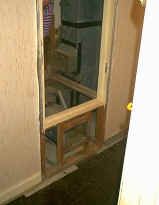
Cupboard Space
-
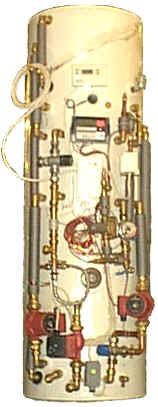
Photo of Heat Bank
-
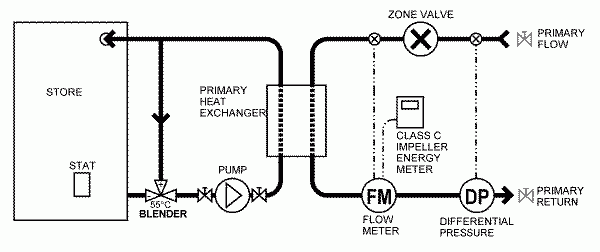
Schematic of Primary Side
-
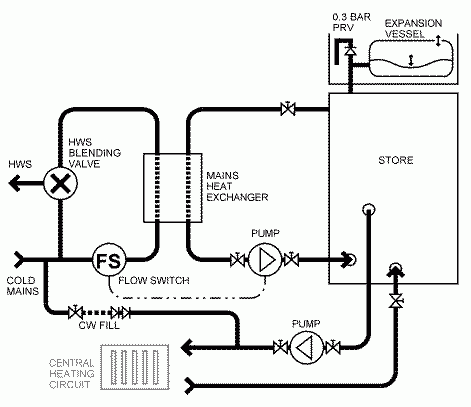
Schematic of Secondary Side
Customers requirements
A hot water and central heating system, to supply multiple dwellings from a central boiler house.
The two tower blocks were of the same construction methods as Ronan Point and as such the use of pressurised storage was not allowed. Ronan Point was a tower block that partially collapsed following a gas explosion, and the potential for an explosion resulting from an unserviced unvented cylinder meant only thermal storage would be possible.
No external overflow or warning pipes desired. The system should be completely 'plug-and-play' with all components factory fitted and tested, and all controls pre-balanced and locked. Controls to include differential pressure control, complete isolation of each system from the primaries, and integral class C heat meters.
Cupboard entrances were only 500mm wide making the use of 480mm diameter units necessary.
The Design
The system presented some additional challenges. A plate heat exchanger must be used to isolate the boiler primaries from the hot water and central heating system. This ensures no cross-contamination of either system, as well as allowing each heating system to be sealed with corrosion inhibitor. To improve boiler efficiencies the return temperatures should be kept as low as possible, in turn requiring the use of some system modulation.
A heat meter was also required. The unit comprises of a heat meter, a flow meter, and two temperature sensors - one in the boiler flow, and one in the return. The heat meter calculates information regarding heat energy input from the primaries, which is sent to a central data store, a sent from their to council offices by modem, allowing the residents to be appropriately billed.
The Solution
The use of our patented Stowaway Heat Bank Thermal Store took care of the requirement for no overflow. The system is manually filled and sealed from atmosphere to prevent water loss. An integral overfill chamber is built in to prevent spills from overfilling, and a low level indicator light shows when water is getting low should any be lost by draining or changing radiators.
Our patented GX recovery system, combined with a plate heat exchanger and zone valve, is used for the primary controls for getting heat into the store, while keeping return temperatures low. Additional requirements were taken care of by fitting the appropriate heat meter, flow meter, differential pressure control, temperature sensors, and pressure sensors.
A plate heat exchanger is used to provide mains pressure hot water, at very generous flow rates, and removes the need for any cold storage. The entire system only requires 6 connections, all push-fit using Tectite brass fittings:
1. Primary In 15mm 2. Primary Out 15mm 3. Mains In 22mm 4. How Mains Out 22mm 5. Flow to Radiators 22mm 6. Return from Radiators 22mm